The best-known Frenchman in China is neither Macron nor Mbappé
– China is no longer content to execute; it orchestrates
Who is the most-followed Frenchman in China this month? Not an actor, not a politician, not a footballer.
A 34-year-old motorcycle racer from Albi named Valentin Debise. On Douyin, the Chinese TikTok, he passed 1.5 million followers in a matter of weeks. Brands are knocking at his door, sponsorship offers are piling up. More recently still, during Race 1 of the Pirelli Czech Round in Most on May 16, the official ZXMOTO livestream on Douyin peaked at 5 million concurrent viewers, and Bilibili’s at 350,000, for a cumulative 28 million views on short videos within 24 hours. Debise, a prophet in China!
Move from Analysis to Action
This report is your foothold. To dig deeper into these signals, audit your strategic position or secure your operations on the ground, start a conversation with our experts.
Let’s rewind a little. A year ago, Debise had no one. He had offered to stay in the world championship with Yamaha and give up his salary. The answer: no, because he was “too experienced”, , in other words too old. At 33, on the brink of personal bankruptcy, he accepted a second-tier seat at Renzi Corse so as not to vanish from the paddock. His career, on paper, was heading for the exit.
On the other side of the paddock, one brand was interested in him. A Chinese brand nobody in Europe had heard of: ZXMOTO, founded two years earlier in Chongqing (China) by a self-taught man named Zhang Xue. Technically, it is a solid start-up. Financially, it is a tightrope walker, on a venture capital drip (a 90-million-yuan Series A closed in January 2026 with Zhejiang Venture Capital Group, a post-money valuation of 1.09 billion yuan, but a net loss of 22.8 million yuan for fiscal 2025). In short, ZXMOTO urgently needed to prove itself. Debise urgently needed to race.
Zhang Xue’s official plan was to conquer the FIM Supersport World Championship gradually over three years: a podium in year 1, a win in year 2, the title in year 3. As this piece is being written, his team has won 5 of the 10 races held, in three months. Everything that happened between Phillip Island, Portimão, Balaton Park and Most is worthy of a Hollywood script. But there is a real rationale behind it.
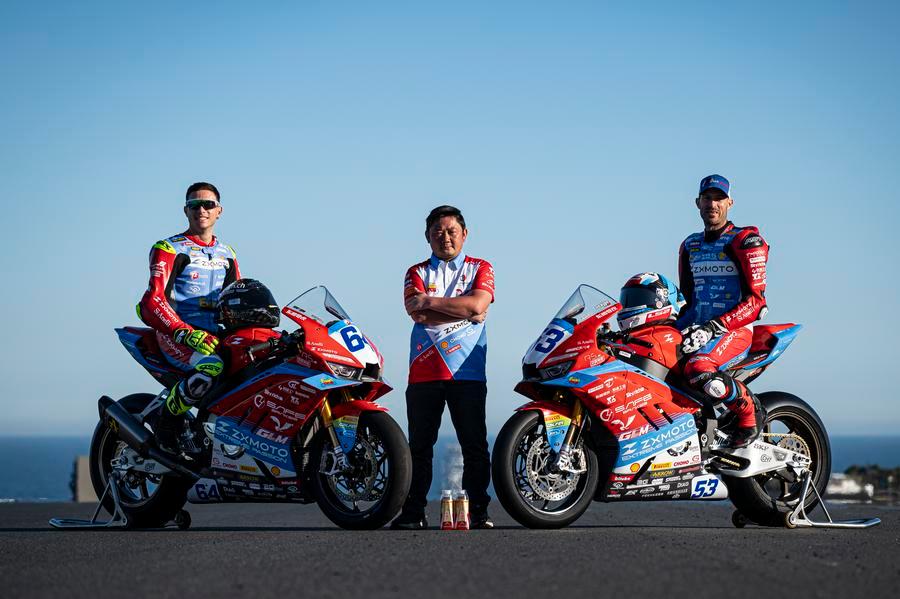
The trio that makes China win
Valentin Debise (34, French champion at 16, MotoAmerica, France, a late return to the world championship). His value goes far beyond his raw record. Zhang Xue saw it clearly: what he was looking for was not just a fast rider, it was an experienced and articulate rider. Someone able to step off the bike and say, in precise technical language, which part of the chassis is working badly on corner entry, where the electronics lack finesse, which point of the engine needs modifying. Fifteen years on parallel circuits give you that kind of vocabulary. For a brand developing its first world championship bike, a rider who can explain is worth ten riders who just lap fast. Too old for Yamaha, just in time for ZXMOTO.
Evan Bros Racing (Ravenna, run by Fabio Evangelista; 8 years with Yamaha, 41 wins, 104 podiums, 3 riders’ titles, 2 teams’ titles). The official break with Yamaha Motor Europe at the end of 2025 was diplomatically packaged: “amicable end to a successful partnership”, “different directions”. The paddock reality is more prosaic. A world-champion team means engineers who want to touch the parameters, modify the mapping, test in real time. At a global manufacturer, every change goes through ten stamps at headquarters; decisions go up, come back down, take weeks. Evan Bros wanted to drive development, not wait for sign-offs. ZXMOTO offered exactly that: a manufacturer ready to let the team build the bike with its own hands.
Zhang Xue (39, founder of ZXMOTO, middle-school education, from a poor village in Hunan). Apprentice mechanic at 16, co-founder of Kove Moto in 2017, pushed out in March 2024 by his partners, who wanted to monetize while he wanted to invest in R&D. He created ZXMOTO a month later. He is the discreet lever of the success. No investment committee to convince, no matrix hierarchy, no sign-off from headquarters. One WeChat call to Zhang Xue, and the requested part arrives at the circuit within the week. A suggestion from the Italian team on frame geometry, and the Chongqing office redesigns, remanufactures, delivers. Debise recounts his first meeting with him at an expo stand: looking for the boss, he asked a guy wiping down a bike with a rag where he could find him. The guy replied: “That’s me.” Debise says he had never seen a manufacturer’s chief executive clean his own bikes.
The “anti-establishment” angle on this trio is tempting, but incomplete. What happened between March and May 2026 is above all a meeting of minds, around a shared conviction: decide fast, execute fast, iterate fast. Debise himself explains it: on an established manufacturer’s bike, the rider’s job is limited to fine-tuning. At ZXMOTO, he and the team were able to feed their technical feedback directly into the design of the machine. That challenge is what made him sign, not just the check.
In terms of management, Zhang Xue’s style is the polar opposite of the corporate jargon of the big motorcycle brands. No “strategic roadmaps”, no “synergies”, no PowerPoint with three levels of sign-off. Nothing but agility and concrete, immediately actionable steps. A concrete case recounted by Debise: during the first test, he asked for a part to be modified. The factory produced the drawing, manufactured the component and delivered it for validation on track, all within one week. Telemetry, lap times and team feedback go back to Chongqing every day.
In terms of financial incentives, the break is even sharper. The terms offered to Debise have no equivalent in the paddock. Podium bonuses are paid immediately, and the rider keeps 60%. At the big established manufacturers, these same bonuses are held until the end of the season and the rider receives only about 15%. Give feedback and reward victory in the moment, not in an end-of-year review: that is Zhang Xue’s signature.
In terms of human commitment, Zhang Xue goes beyond the contract. He hired Debise’s wife onto the team, a discreet but clear way of anchoring the relationship for the long term. After the Portimão double, he was already promising Debise that he would retire at ZXMOTO.
It is this agility at every level, and this total absence of organizational inertia, that served as the lever for sporting success. Debise and Evan Bros Racing gave it everything. Zhang Xue had planned a podium in year 1, a win in year 2, the title in year 3. The first two milestones were reached in three months. The 2026 title, which was not in the plan, has become a credible option.
Debise explains his working method with ZXMOTO in this video:
Join the 1% who read the user manual for China.
Sign up for free to receive my analysis every week and get your complimentary guide “Digital Survival in China”.
What this tells us
First point, rarely discussed: China-Europe industrial collaboration has just moved up a level. We are no longer in the "China manufactures, Europe designs" scenario. We are in co-design at the highest technical level, with a world-champion Italian team developing a Chinese machine and a French rider validating engineering choices in real time. China is not subcontracting; it is assembling global teams.
Nor is the ZXMOTO case an isolated one. Xiaomi, which entered the electric car business in 2024 with the SU7, opened an R&D center in Munich in 2025, staffed with former engineers and designers from BMW, Mercedes-Benz, Porsche, Lamborghini and AMG. Among them: Rudolf Dittrich, fifteen years at BMW, with stints at Williams and Sauber in F1; Kai Langer, twenty years at BMW, former head of design for BMW i; Hubert Huegle, ex-AMG, now head of hardware development. The logic is identical to that of Evan Bros and Debise, transposed to a larger scale: don't reinvent what others took fifty years to learn; hire it directly.
Notably, on the ZXMOTO side, China's official media themselves (People's Daily, Xinhua, China Daily) openly praise the contribution of Debise and Evan Bros. It is a concrete, compelling case of international cooperation that works.
Second point, more uncomfortable for the national narrative in Beijing: ZXMOTO alone would not have won. The 820RR-RS is technically accomplished (the 3.685 s gap at Portimão is a fact). But it is Evan Bros's racing methodology and Debise's articulate experience that turn a fast bike into a winning bike. The triumph is Chinese on the factory side, Italian-French on the track side. The three are inseparable.
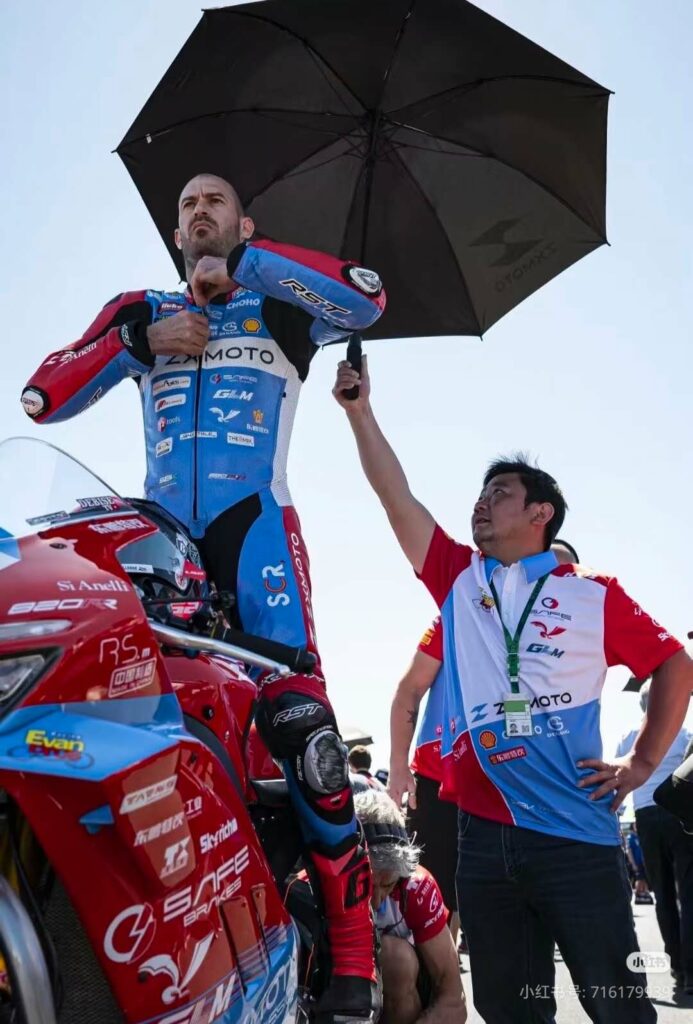
On Chinese social media, one photo is circulating on a loop: the French rider standing on his bike, the Chinese founder beside him holding his umbrella. The hero is foreign, the local boss is doing him a service, and nobody takes offense. On the contrary, the public applauds. A sign of a China that has come of age.
The image of China as the low-cost workshop of the rest of the world is outdated. The country is reconfiguring itself as a host platform for global skills and technologies.
Takeaways
For Chinese players. Surrounding yourself with experienced veterans and with teams that have broken with their historical partner works better than trying to poach active stars.
For European players. A 34-year-old rider who offered to race for free at Yamaha and was turned down, an Italian team that wanted to regain control of its development: both have just found, with an unknown Chinese entrepreneur, what their home ecosystem no longer offered them. How many other Debises, other Evan Bros, are still waiting in Europe? Reaching out to the Chinese can produce results that surprise both sides.
For the sports market. Before Portimão, WorldSSP had virtually no audience in China. The May 16 broadcast totaled > 30 million views on social media. Debise has passed 1.5 million followers on Douyin. The ZXMOTO store's post-victory livestream drew 1.53 million viewers, 5,543 firm orders for the 820RR (selling at ~44,000 RMB / €5,000) were recorded in a single day, and according to Xinhua pre-orders jumped 200% in three days. A Chinese manufacturer's arrival in a world championship mechanically creates a Chinese audience, hence broadcast value, hence sponsorship revenue, hence, in the medium term, Chinese rounds on the calendar. High-end motorcycle racing in China has just tipped from a niche category into a media market of real weight. Ducati and Yamaha will, in turn, have every interest in going there.
For brands. There is a fourth winner in this story, more discreet than the other three: Dongpeng (东鹏特饮), China's leading energy drink, a direct rival to Red Bull in its home market and virtually unknown abroad. Dongpeng signed on as ZXMOTO's main sponsor at a time when no one else wanted to put a single euro into it. A long-term bet, with no short-term visibility. Three months later, the Dongpeng logo is on millions of Chinese screens during every race. Jackpot. For other brands, Chinese and Western alike, the question is open: when will you, too, put a little risk on a Zhang Xue of tomorrow?
Do you have a matter that could benefit from an outside perspective?