Beyond Analysis
Information alone is no longer enough to secure a deal. For your investments, JVs, complex negotiations or cross-border facilitation, MadameChina supports you as a strategic partner.
Decathlon’s Exit – China De-risking
How the “Tech War” Is Shaping China’s Macroeconomic Cycle
🟥 EXECUTIVE SUMMARY
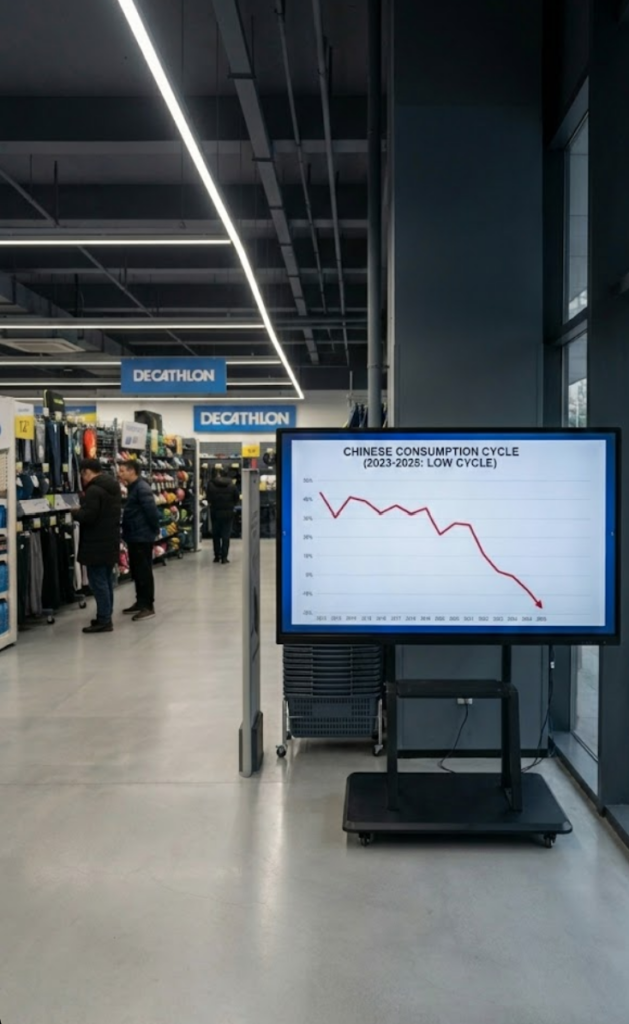
The current European consensus advocates “China de-risking”: an orderly exit or a drastic reduction of exposure to China. Rumors of a partial sale of Decathlon China (30%) are being read as validation of this thesis: “If even the sporting goods leader is leaving, the market must be dead.”
My diagnosis is decidedly different and more nuanced. We are not facing the end of a market, but the low point of an artificial transition cycle.
- The Cause: To secure its technological autonomy (“Tech War”), China has massively reallocated capital toward priority industries (Chips, AI, EVs), temporarily creating overcapacity and deflation in consumer sectors.
- The Brake: The wealth created by these new sectors (Chips, AI, EVs) has not yet trickled down to the middle class, which is also suffering from the real-estate correction and feels poorer. As a result, the savings rate has risen to 37%.
- The Opportunity: This divergence cannot last: domestic demand must become a priority again. The 2026-2027 horizon demands price stabilization and a revival of domestic demand to consolidate the gains.
For an executive, selling today means locking in a discount at the worst possible moment. The cycle will turn, because the Chinese economy needs the consumer to validate its move upmarket. The recommendation is clear: Hold the position (“Hold”) and prepare the quality pivot.
I. THE HOOK: LOW CYCLE AND ARTIFICIAL ASPHYXIATION
You have to picture Decathlon‘s position to understand the anomaly. This is not a foreign brand artificially dropped onto Chinese soil. It is a company that grew up alongside modern China.
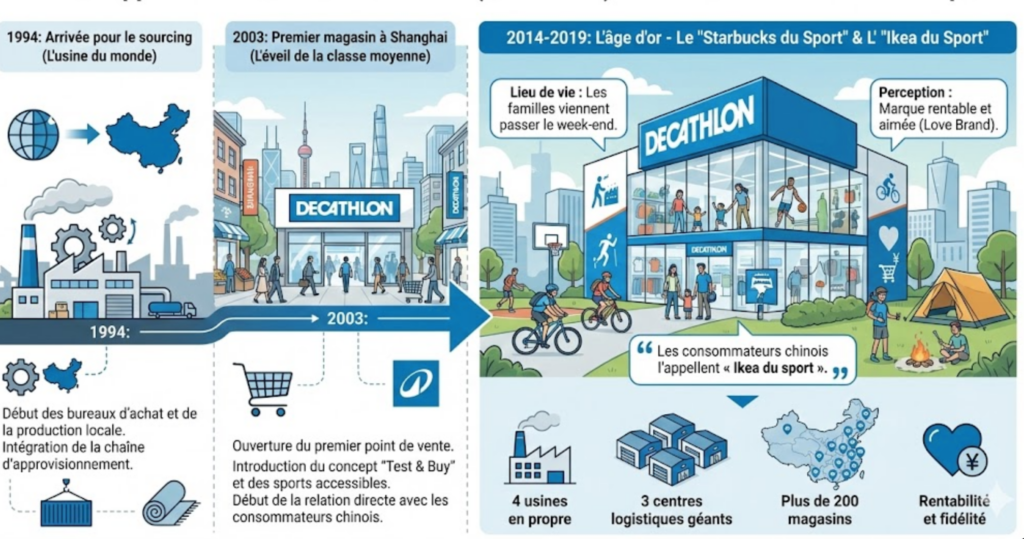
- 1994: Arrival for sourcing (the factory of the world).
- 2003: First store in Shanghai (the awakening of the middle class).
- 2014-2019: The golden age. Decathlon becomes the “Ikea of Sport”, the place where families come to spend the weekend. The model is a fortress: 100% integrated, 4 in-house factories, 3 giant logistics centers, more than 200 stores. It is a profitable and beloved brand (Love Brand) – Chinese consumers call it the “Ikea of sport”
Yet at the end of 2024, the market panicked. Bloomberg and Reuters reported that the retailer was looking for a partner to buy 30% of the subsidiary, valuing the whole at 1 billion dollars. In Europe, the conclusion was binary: “The geopolitical risk is too high, they’re packing up.”
The Madame China Analysis: Look at the facts, not the fears. Decathlon’s current performance does not signal a structural flaw in the brand; rather, it acts as the mirror of a cyclical low. It mechanically reflects the “temporary depression” of a middle class that, out of caution, has locked its wallet. If the sale process is stalling, it is not because the asset is toxic or distressed, but because the financial counterparty has been redirected. Five years ago, the big funds (Hillhouse, Sequoia China) would have fought over this deal. Today, their checkbooks are politically earmarked elsewhere: “Everything for chips, nothing for sneakers.” This blockage is artificial and cyclical: it results from a state allocation that temporarily starves retail of oxygen in order to over-ventilate Hard Tech. Decathlon is not sick; it is simply holding its breath in a market where the air (liquidity) has been redirected.
II. PHASE 1: CHINA’S GREAT MACRO DIVERGENCE (2014-2024)
To understand why the oxygen was cut off, you have to analyze the “engine room” of the Chinese economy. It no longer runs on the same engine as the West.
1. The Western Model: Demand as the Foundation
In the United States and France, the reading is linear.
- USA: Household consumption (PCE) is king. It accounts for ~70% of GDP. Whether there is inflation or high interest rates, the American consumer sustains growth (~2.5% in 2024).
- France: Consumption is the stabilizer (~52-53% of GDP). Investment fluctuates, but the household shopping basket holds the fort.
2. The Chinese Model: Open-Heart Surgery
China is undergoing a structural transformation of unprecedented violence, invisible to the naked eye of a tourist, but glaring in the balance sheets.
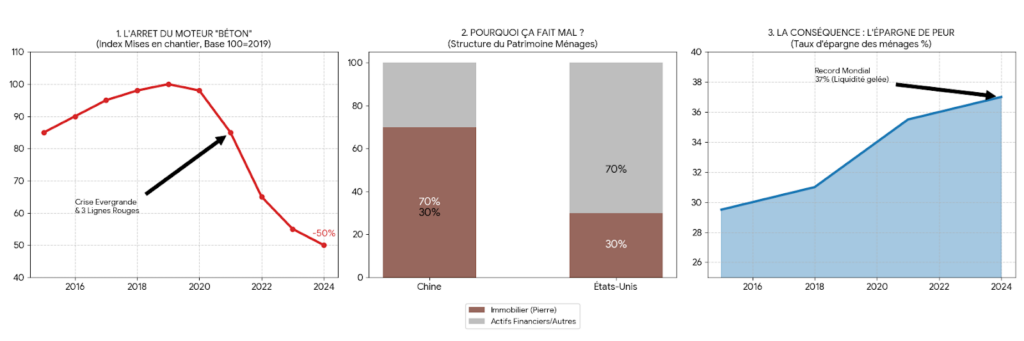
- The Collapse of the “Concrete” Engine: During the 2010-2020 decade, investment (Real Estate + Infrastructure) accounted for up to 45% of GDP. It was the era of speed. Since the Evergrande bankruptcy (2021) and the “Three Red Lines” policy, this engine has stalled. Housing starts have fallen by more than 50%.
- The Destruction of the Wealth Effect: In China, 70% of household wealth is in property (versus ~30% in the US). When real-estate prices fall by 15% to 30% in major cities, the average Chinese person feels poor.
- The Consequence – Fear-Driven Saving: the household savings rate jumped from ~30% before Covid to nearly 37% in 2024. That’s billions of RMB in liquidity frozen by fear, missing from retail cash registers.
Key takeaway: China is moving from an economy of Volume (7-8% easy growth) to an economy of Quality and Security (~5% hard-won growth). This painful interval is where Decathlon finds itself today.
III. PHASE 2: DECODING THE SYSTEM — THE TECH WAR ECONOMY
Why doesn’t Beijing inject cash into households (like the COVID checks in the US) to restart the machine? Because the priority has changed.
1. The Crowding-Out Thesis
Faced with US sanctions (Chips Act, ASML blockade), China has been declared a quasi-war economy. The objective is no longer GDP; it is Technological Sovereignty.
- Trillions of yuan in state loans are earmarked for the “New Productive Forces” (New Three): Electric Vehicles, Batteries, Solar, and above all Semiconductors/AI.
- It is a brutal capital-allocation choice: financing the factory of the future by temporarily sacrificing the comfort of the present. The “Daily Life” sector (Retail, Food, Services) is being starved of capital.
- The tap is shut: since the so-called ‘Red Light’ policy was introduced on the Shenzhen stock exchange, IPOs in the ‘Food & Beverage’ and ‘Clothing chains’ sectors have virtually ground to a halt. Even giants like Mixue Bingcheng have had to postpone their listings. Capital is being directed by decree toward Hard Tech.
2. Decathlon: Caught in the “Sandwich” Squeeze
In this context, Decathlon is caught in the middle:
- Consumer Downgrading: The worried middle class is looking for rock-bottom prices. It is flocking to Pinduoduo (PDD/Temu) or “White Labels” (factory brands) on Douyin. A technical T-shirt sells there for 19 RMB.
- Ill-Suited Positioning: Between 2022 and 2024, Decathlon tried to move upmarket (average basket rising from ~130 to ~196 RMB).
- The Result: Too expensive for those counting every yuan, not “status” enough for those who buy Lululemon or Arc’teryx (which are performing very well). Decathlon is stuck in the middle, exactly where deflation hurts the most.
3. The Counter-Example: Don’t Confuse Decathlon with Starbucks
It is crucial to distinguish between exit cases.
🔎 Comparative Zoom: Structural vs Cyclical
-
🛑
The Starbucks Case (A Double Whammy):
1) It is a geopolitical target (US Soft Power).
2) Its model is obsolete compared to Luckin Coffee (20,000 outlets, 100% digital, aggressive delivery).👉 The 14% drop in sales is structural and competitive. -
✅
The Decathlon Case (A Temporary Trough):
The European brand is “politically neutral”, even well regarded (a creator of industrial jobs). Its difficulties are purely cyclical (temporarily squeezed purchasing power).
💡 Conclusion: Starbucks is leaving because its model is broken and its flag is a burden. Decathlon is suffering because the cycle is low. It’s not the same story.
IV. PHASE 3: THE INEVITABLE PIVOT
This is where the Madame China analysis becomes forward-looking and differentiated. Why is it too early to leave?
1. The Supply-Side Dead End
China has won the supply battle (it is flooding the world with solar panels and EVs). But it is hitting a wall:
- Europe is imposing tariffs.
- The US is closing the door.
- Even Brazil and Turkey are raising barriers. Exports will no longer be able to absorb Chinese overcapacity.
2. The Stability Imperative
To win its technology bet, China needs a robust domestic market. You don’t finance cutting-edge innovation with a deflationary economy. The stated objective for late 2025/2026 is now “Price Stabilization”. The state will step in to rationalize supply and stop the destructive price war.
3. Proof of the Pivot – The December 2025 Signal (CEWC)
🏛️ The Pivot Signal: The December Conference (CEWC)
This is the new element that changes the game for 2026. The government has blown the whistle on the deflationary free-for-all. The roadmap has changed radically:
-
🚀
The Concrete Action:
Launch of a “Special action plan to boost consumption” and a plan to “Increase the incomes of urban and rural residents”.
-
🥇
Absolute Priority No. 1:
“Persist with domestic demand as the main driver” (坚持内需主导). It is no longer a slogan; it is the first of the 8 priority tasks, ahead of industry.
-
📈
The Unprecedented Keyword:
“Promote a reasonable recovery in prices” (物价合理回升). The state is officially declaring war on deflation and “involutionary competition” (price wars).
4. The 2027 Horizon
2027 will mark a major institutional milestone (renewal of mandates). China’s economic history shows that such periods are always preceded by a drive for social consolidation. The “prosperity contract” must be renewed. This mechanically implies:
- Support for purchasing power.
- A greater emphasis on services (Health, Leisure, Quality of life).
- The end of the real-estate purge.
V. BUSINESS ACTION — THE STRATEGY OF RIDING OUT THE STORM
If you sell now, you sell at a discount. Here is the suggested roadmap:
- Finance: Optionality rather than Exit. Don’t give up control. If you need cash, open your capital to a strategic minority partner (such as a local distributor or logistics provider), but keep the keys to the truck for the 2026 rebound. Consider cross-shareholding with the strategic partner, who is suffering from this cyclical low as much as you are.
- Operations: “Local for Local”. The days when Lille or Paris decided the collections are over. Chinese speed of reaction (Shein style) demands 100% localized management. Empower them to fight on Chinese social networks (Red Note/Douyin) to strengthen social selling.
- Political Repositioning: “Public Health”. Forget “Leisure”, talk “Health”. China is aging. The government is desperately trying to keep its population healthy to reduce medical costs. Decathlon should become the partner of a “Fit China”. It’s a politically bulletproof narrative that opens the doors of municipalities and protects against geopolitical uncertainties.
V. CONCLUSION & OPTIMISM
What this means for you ?
China is not “finished”; it is “under maintenance”. It is changing engines mid-flight, switching from the “Construction” turbo to the “High Technology” hybrid engine. This operation is creating severe turbulence for consumption. But the fundamentals (urbanization, the shift to services, the need for quality of life) are intact. Those who leave today are footing the bill for the crisis (losses, restructuring) and handing the market on a silver platter to local competitors who, for their part, are waiting for the stimulus.
Madame China’s final word:
“In China, patience is not a virtue; it is a financial-analysis skill. Don’t confuse a cyclical slump with a strategic divorce. The Chinese government needs the consumer to survive; be there when it pulls out the checkbook.”
Do you have a case that could benefit from a fresh perspective?