Beyond Analysis
Information alone is no longer enough to secure a deal. For your investments, JVs, complex negotiations or cross-border facilitation, MadameChina supports you as a strategic partner.
A €4.70 Matcha Latte on Boulevard Saint-Michel: Chinese ‘New Retail’s’ Bold (but Risky) New Bet in Paris.
By Madame China
If you walk down Boulevard Saint-Michel this week, between the Gibert bookshop and a souvenir store, you may notice a small bright-red storefront. No giant billboards, no influencers lining up, at least for now. It’s a discreet “soft opening”.
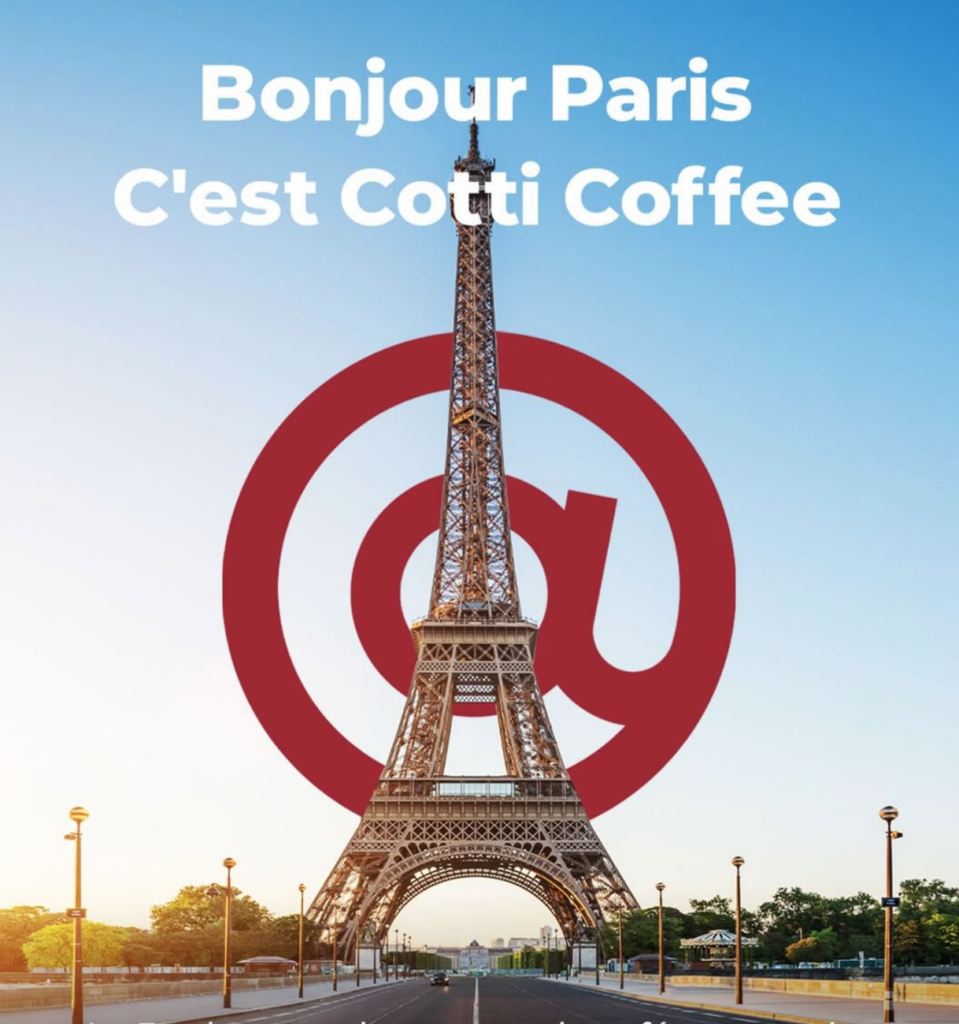
And yet something rather rare is happening in these twenty square meters: the arrival of a player that isn’t here to “make coffee” in the Parisian sense of the term, but to test an efficiency equation and an operating model engineered for success. Cotti Coffee, a Chinese chain launched by the former founders of Luckin Coffee, already claims more than 10,000 outlets worldwide and is opening its first Parisian “station” here.
Curious, I went to test it for you. Phone in hand (practically mandatory), promo code applied (automatically) and order placed, everything happened in the app: a Matcha Latte.
The verdict, quite simply:
- The Taste: Surprising. A far cry from industrial dishwater. It’s creamy, and the flavor delivers.
- The Experience: 90 seconds flat from ordering in the app
- The Bill: €4.70 list price… and €1.99 after the promo!
In a neighborhood (Luxembourg Gardens, Sorbonne…) where a cappuccino easily approaches 7 euros, this is a genuine economic shock.
But make no mistake: this price is not a gift. It is the product of a business model combined with an industrial logistics strategy that, after successes in China and painful failures abroad, is trying to crack the Parisian code.
Let’s decode it.
1. The “Chinese Recipe”: A Tech Company Disguised as a Café
To understand why your coffee is so cheap, you need to look at what Cotti Coffee actually is. Behind the brand are Lu Zhengyao and the former founders of Luckin Coffee. They are not artisans; they are engineers of scale: people who turn a daily routine into an industrial system.
Their model rests on three invisible but formidably effective pillars:
- The App is the conductor: In China, more than 70% of orders go through the App. This reduces errors, eliminates the traditional cash register and optimizes flow. Cotti doesn’t sell service; it sells a system.
- The Integrated Supply Chain: This is the core of the engine. Cotti owns its own roasting and syrup factories. It buys raw materials for more than 10,000 stores at once. It is this colossal volume that crushes costs.
- The “Low Cost” Franchise Model: Unlike a McDonald’s, which requires a huge upfront investment, in China Cotti lets you open a store with a very low entry ticket. The brand makes its money not from royalties, but by selling raw materials to franchisees and sharing net profit (the famous profit sharing scheme).
2. The Local Opportunity: Savior of the “Broom Closets”
For Parisian real estate, Cotti could be a windfall. The city center (Rivoli, Saint-Michel) is full of “gaps”: 15 to 30m² units that are impossible to lease to major clothing brands and too expensive for artisans.
Cotti’s compact, low-cost format needs zero seating. All they need is a counter and power outlets. They turn these “dead” square meters into cash-flow machines.
The result: these commercial “broom closets”, often hard to rent out, suddenly become viable. And for a landlord, it’s tempting: a high-throughput model can sustain a rent that would break a more traditional business.
3. The Comparison: Why Starbucks Isn’t Trembling (Yet)
We can already hear it: “It’s the end of the bistros!”. Let’s calm down. Cotti isn’t playing in the same league. Here’s why they won’t kill your usual hangout:
Cotti captures the customer in a hurry (young professionals, students, tourists on foot) who wants “fun” (Mango Latte, Grapefruit, Coconut Matcha) without paying for the décor.

4. The “Parisian Bet”: Can Cotti Really Succeed Here?
This is where the Madame China analysis steps in to cool things down. “Copy-pasting” the Chinese model is extremely risky. Global data shows that Cotti struggles as soon as it leaves China:
- The Korean Graveyard: In 2023, Cotti attempted a breakthrough in South Korea. The result? A complete shutdown. The market was saturated and they failed to adapt to local apps (Kakao).
- The North American Pain: In the US and Canada, Cotti is struggling and not yet very profitable. Rents and wages there are too high to make low-priced coffee pay off. The payback period, which is 1 year in China, stretches to 3-5 years there.
5. The Parisian Crash Test: Does the Economic Equation Hold Up?
The euphoria of “cheap Matcha” runs up against the wall of French economic reality. Cotti triumphed in China, but Paris is not Shanghai. Copy-pasting the model is likely to stall on four critical points.
- Razor-Thin Margins vs. Parisian Costs: Selling a Latte for €4.70 is easy. Making money from it is a feat. Cotti’s equation relies on massive volumes to offset low unit margins. Yet the cost structure in Paris is brutal. A square meter on Boulevard Saint-Michel costs a fortune, even for a “closet”. More dangerous still: labor costs. In Paris, with the minimum wage (SMIC) and employer social charges, a barista is expensive. The math is quick: to pay rent, wages and raw materials on such a thin margin, a store has to sell more than 400 cups a day, every day. At the slightest slowdown, the store loses money.
- The Logistics Challenge: A Supply Chain 8,000 km Away Cotti’s strength in China is the proximity of its factories. But in Europe, shipping syrups, beans and consumables from Asia comes with a cost and a carbon footprint. If Cotti wants to keep prices low over the long term, it cannot simply rely on imports. It will have to build a local or European supply chain, which represents a heavy investment. Until that happens, its margin is eaten up by logistics.
- The Culture Shock: “The App” vs. “The Flâneur” The Cotti model assumes absolute fluidity: the customer orders on the App before arriving, picks up the coffee and leaves. Zero friction. But while in China 70% of orders are delivery or pre-orders, in Paris coffee delivery (UberEats-style) caps out at 15%. Parisians like to order at the counter. The operational risk is real: if customers crowd around the counter to download the app, scan QR codes that won’t load (overloaded network) or ask for explanations, the speed machine jams. And if speed drops, profitability collapses.
- The Promotion Illusion (Customer Stickiness): Finally, there is the trap of “false loyalty”. Today, the curious (like me) come for the price and the novelty: that’s the promo effect. But Cotti is known for its “scorched earth” strategy (subsidizing prices to kill the competition). The real question is sustainability: once the launch period is over, will customers stay? The Parisian consumer is opportunistic. Without rock-bottom prices as an argument, will they go back to the premium experience of a Starbucks or the artisanal quality of their neighborhood Coffee Shop? Loyalty to an app is far more fragile than loyalty to a place.
6. Conclusion: A Necessary Wake-Up Call and Preparation for the Future
Whether it wins its bet or pulls out as it did in Korea, Cotti Coffee’s arrival in Paris will leave a lasting mark. It is a full-scale “Crash Test” from which we must draw lessons immediately.
- A victory for consumers (and the end of impunity): This is the end of “mediocre, expensive coffee” served out of habit. Cotti forces the Parisian market to take a hard look in the mirror. If a chain can serve a decent-quality Matcha for €4.70 in the heart of Paris, why should we pay €6 for a similar product elsewhere? It’s a win for purchasing power and raises the bar on quality.
- Real estate: The redemption of the “closets”: For landlords, it’s proof that a microscopic format (15-20m²) can generate massive revenue. The “High Volume / Low Surface” model is the key to bringing back to life the hundreds of small vacant retail units in the capital.
- The real stake: Creating a “French-style Cotti”: This is the most critical point for our entrepreneurs. Don’t look down on Cotti; look at them as a laboratory. The challenge isn’t to copy their recipes, but to hack their operating system and adapt it to our market.
- Operational efficiency: Adopt App ordering and flow optimization to cut waiting times and costs.
- Local adaptation (the French “Plus”): Where Cotti is weak (distant supply chain, carbon footprint, industrial image), a local player can triumph. Imagine Cotti’s digital efficiency, but with French milk, local roasting and a short European supply chain.
Why is it urgent?
Cotti is only the scout. Other Chinese giants (such as Mixue for ice cream and tea) are eyeing the European market hungrily. If French players don’t modernize their “back office” (Supply Chain + Tech) now while keeping their soul, they will be swept away by the next wave.
Cotti offers us a rare opportunity: to observe its strengths and weaknesses in real time in order to build, starting tomorrow, a hybrid, modern and resilient model.
The match(a) is on. The ball is in our court.
Do you have a case that could benefit from a fresh perspective?