Beyond Analysis
Information alone is no longer enough to secure a deal. For your investment decisions, JVs, complex negotiations or cross-border facilitation, MadameChina works alongside you as a strategic partner.
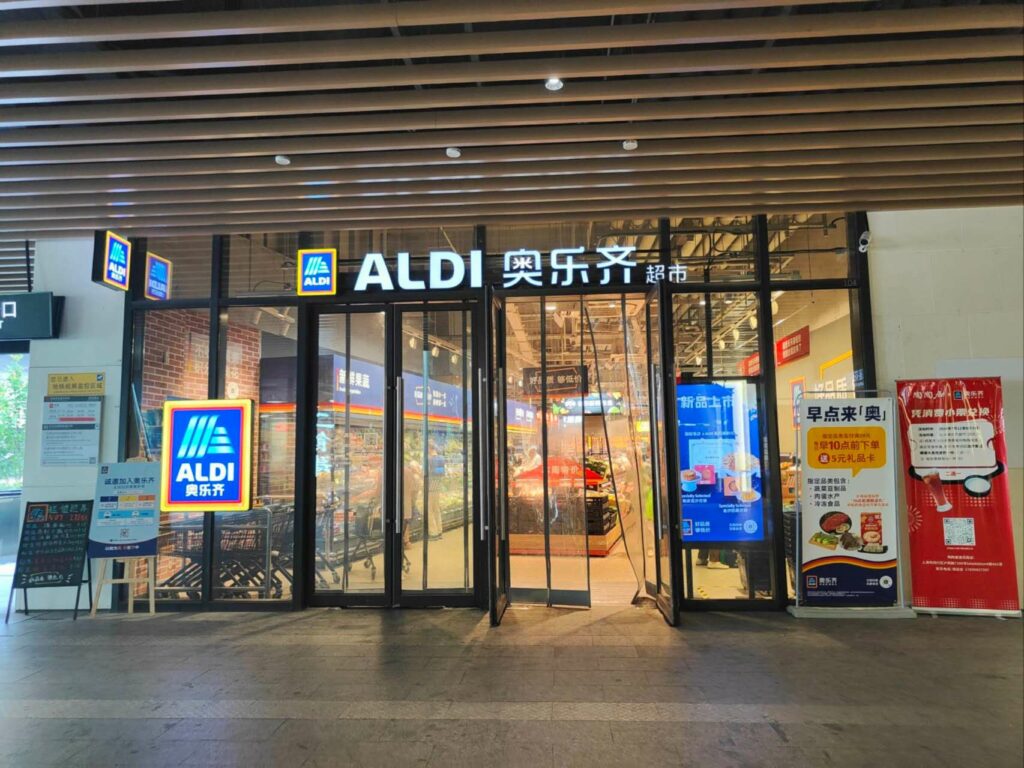
Aldi in China: Understanding China’s Transformation Through the Aldi Lens
Preface:
Why study Aldi in China? Because the Chinese market is not “volatile” — it is in permanent transformation, inherently dynamic.
What looks like decline often masks a transition. 东方不亮西方亮: when one light goes out, another comes on.
For FMCG and luxury players, the challenge is not merely to claim to be “local and agile”, but to actually be so.
The parent company’s passport is no longer a glass ceiling: Aldi’s brazen success proves that China does not penalize origin but a poorly adapted model, even amid deflation and a reverse trading-up (downgrading) of middle-class consumption.
This requires a dynamic reading of the market, bringing in more young local talent, and going deep on the ground to pick up the weak signals of an environment (势) that reinvents itself every three to five years.
Introduction:
While the flagships of the German auto industry are steadily losing ground in China, another German player is rewriting the rules of retail in Shanghai. Its method? The efficiency of a business model proven in Europe, combined with radical local flexibility. Your “brand heritage” may well be a shield, but you may be surprised to find that adapting to China has become the only real weapon of conquest. Here is our analysis.
1. The Reality Check
China’s consumer landscape in 2026 bears no resemblance to what marketing textbooks taught five years ago. Officially, retail grew +3.7% in 2025, reaching a staggering RMB 50.12 trillion (about USD 7.15 trillion). On the surface, the engine is running. In reality, we are witnessing a tectonic rift.
1.1 The Fracture Matrix (2023-2025)
The market is not slowing down; it is fragmenting violently. We are witnessing a brutal purge of inefficient models (classic “Modern Trade”) in favor of agile, innovative ones.
Table 1: Distribution Channel Performance Matrix
| Channel | Growth 2024-25 | Key Players | Success Keys / Decline Factors |
|---|---|---|---|
| Instant Retail (O2O) | +28.9% | Meituan, Jingdong (JD.com) | Last-mile logistics, delivery < 30 min. |
| Membership Warehouses | +22% to 30% | Sam’s Club, Costco | Exclusivity model, Premium/Volume ratio, private labels. |
| Hard Discount (incl. snack stores) | +15% to 20% | Aldi, MMHM | Radical operational efficiency, 90% private labels. |
| Livestream Commerce | +20% | Douyin, Taobao Live | Entertainment, impulse buying, KOL ecosystem. |
| Hypermarkets | -7% to -10% | Walmart, Carrefour | Obsolete “Modern Trade” model, high fixed costs, offline exodus. |
| Department Stores | -2.9% | 百货 (regional centers) | Lack of differentiation, homogeneous branding, weak experience. |
1.2 The Slaughter of the Dinosaurs
Behind the national average lies a massacre for traditional brick-and-mortar retail. Offline FMCG (fast-moving consumer goods) is undergoing a violent contraction, with negative growth of between -0.7% and -5%. The “Modern Trade” model — the ring-road hypermarket and the neighborhood supermarket — has officially entered its death throes.
The numbers speak for themselves:
- More than 720 supermarkets closed their doors in the first half of 2025 alone.
- Carrefour has all but exited the market, unable to pivot in time.
- Walmart, despite its firepower, has cut 150 units from its hypermarket network since 2020 (only 279 remain, down from 412).
- Even local players are suffering: Zhongbai Group closed 30 hypermarkets in 2025, the vast majority due to unsustainable losses.
Why this carnage? Because the general-merchandise hypermarket is squeezed between soaring fixed costs (rent and wages) and a generic offer with no differentiation whatsoever compared with e-commerce. Above all, hypermarkets have been swept aside by O2O (Online-to-Offline) and platforms such as Meituan and Ele.me, which can deliver any product in under 30 minutes. As they lose their stores, these giants lose their volume, their bargaining power and, ultimately, their raison d’être.
2. The Big “Surprise”: Growth Driven by Two Foreign Retailers
Offline retail is not dying; it is polarizing radically. Amid this chaos, three formats are emerging as the big winners of 2025: Hard Discount (+92%), snack stores (+51%) and Membership Stores (+40%).
At the top of this new pyramid sit two foreign retailers: America’s Sam’s Club (Walmart) and Germany’s Aldi, which introduced and reinvented the hard-discount model in China.
Sam’s Club: The Premium Fortress
Walmart has succeeded where Carrefour failed by betting everything on Sam’s Club. At the end of 2025, the chain had 62 stores and had opened 10 new ones in a single year, an all-time record. Their secret? They don’t sell products; they sell membership of the upper middle class. With 8.6 million members and e-commerce accounting for more than 50% of sales, Sam’s has created an offline “treasure hunt” experience that Taobao cannot replicate.
Aldi: The Agile Infiltrator
In contrast to Sam’s sheer scale, Aldi has chosen the path of urban infiltration. With 90 stores at the end of 2025 (starting from zero in 2019), Aldi is posting meteoric growth of +100% YoY. In Shanghai, the chain had already reached 20% of households by early 2025. German efficiency meets Chinese agility to turn hard discount into a “premium neighborhood store” that is indispensable in daily life.
| Dimension | Sam’s Club | Aldi |
|---|---|---|
| Positioning | Premium Membership | Hard Discount |
| Format | Large quantities (Bulk) | Small neighborhood formats |
| Assortment | 5,000 SKUs | 2,000 SKUs |
| Key Strength | Exclusivity & Omnichannel | Efficiency & Localization |
3. Deep Dive: How Aldi “Cracked” the China Code
Admittedly, Aldi benefited from an exceptional alignment of the planets: by launching in the eye of China’s economic storm, the chain managed to “go with the flow” (shùn shì) with rare intuition. China’s middle class is currently going through a phase of deep consumption downgrading, a phenomenon we already analyzed in Decathlon’s strategic pivot. Against this backdrop of squeezed purchasing power, Aldi pulled off a masterstroke of positioning: it does not present itself as a mere hard discounter — a label often synonymous with compromised quality in China — but as a “deflated” version of Sam’s Club.
In Shanghai and the affluent surrounding cities, Aldi offers exactly what consumers are desperately looking for: keeping up appearances and their standard of living (the famous tǐmiàn) despite the downturn. Backed by European quality standards, Aldi lets people consume “premium” without paying the entry ticket of membership fees or putting up with the excessive volumes of warehouse clubs.
Here are two distinct consumer profiles that Sam’s Club and Aldi have managed to identify and attract.
- Status: Upper-middle-class urban family
- Need: Food safety, distinction and affordable premium
- Keyword: Membership exclusivity, value for money 划算(huasuan)
- Habit: Family “treasure hunt” expedition
“Shopping at Sam’s means guaranteeing my family a higher, more distinguished standard of living without breaking the bank.”
- Status: Active urbanite, city center (Shanghai)
- Need: Food safety, dignity 体面(Tǐmiàn) and budget efficiency 划算(huasuan)
- Keyword: Inexpensive 便宜(pianyi), superior value for money
- Habit: Proximity, digital-first and small formats
“I refuse to trade down. Aldi lets me keep my shopping habits and my Western lifestyle without paying the high price of marketing.”
3.1 The Cultural Pivot: From “Hard Discount” to “Proximity Premium”
Aldi has never betrayed its essence — German rigor — but it has completely reinvented its surface.
- The Unchanged Essence: An ultra-lean assortment of 2,000 SKUs (versus 50,000 for a classic hypermarket), 90% of them private labels. This allows total control of the supply chain, fast turnover (Just-in-Time) and guaranteed low prices without artificial promotions.
- Deep Adaptation and Winning Differentiation: Aldi understood that in China, discount must not look like discount. In China, “cheap” often goes hand in hand with “suspect”. Aldi turned this stigma around: its private labels are positioned as “controlled European quality” at a fair price.
3.2 Local Emotion as a Weapon of War
Aldi’s adaptation is not cosmetic; it is anthropological. Its former CEO Christoph Schwaiger, obsessed with the field, spent 3.5 years researching before the launch, visiting 40 cities and analyzing 1,000 stores. His philosophy? “Understand China through its three daily meals”. He learned to eat xiaolong bao the proper way before deciding which products to put on the shelves.
The results:
- Precision gastronomy: Where a European Aldi would sell a vacuum-packed block of beef, Aldi China offers 7 different cuts specifically suited to local cooking methods (boiled, braised, stir-fried, stewed). You will find hotpot ingredients unavailable in Germany and traditional snacks such as the famous “butterfly pastries” from Shanghai’s Park Hotel or local temple specialties.
- The store as a “Community Hub”: Unlike the German warehouses, the Chinese stores are places to live in. They are located in high-traffic areas: metro stations and business districts. A major point of differentiation from Sam’s Club, which sits on Shanghai’s outskirts.
- “Flex” Marketing and Virality: In 2024, Aldi plastered the Shanghai metro with tongue-in-cheek job ads to tout its quality standards. Looking for buyers “able to run between hemispheres with six arms” or quality inspectors “picky enough to run 30 checks” was not recruitment; it was a show of strength. Aldi even sent its advertising buses to circle in front of Hema (Alibaba) stores. All of this generated buzz on social media.
3.3 Native Digitalization
Aldi China is not a physical retailer that went online; it was born digital in China via Tmall before opening its first store. In 2025, its integration into the Meituan ecosystem generated GMV growth of +36%. The store is no longer a final destination; it is a logistics node for rapid delivery.
3.4 Execution: Local Supply Chain and Chinese Tempo
Aldi’s success rests on an invisible but formidable engine: a supply chain that is more than 80% localized. With over 400 suppliers concentrated in the Yangtze and Pearl River deltas, Aldi guarantees maximum freshness and minimal logistics costs.
Expansion through execution at China speed
Aldi follows the German playbook of regional saturation:
- 2019-2024: Dominate Shanghai (72 stores).
- 2025: Expand into the Yangtze River Delta (Suzhou, Wuxi).
- 2026: Conquer southern Jiangsu. The logic is relentless: never attack a new area without logistics efficiency and saturated local brand awareness. It is an “oil stain” strategy, as opposed to the costly dispersion of French groups.
4. Takeaways for the C-Suite: Why does the Aldi China case deserve the attention of FMCG and luxury decision-makers?
Because it corrects several persistent misconceptions about the Chinese market.
- Chinese “volatility” is transformation, not instability.
Many European executives describe Chinese consumers as unpredictable, fickle and hard to retain. In reality, what we observe is not erratic behavior — it is the product of a market in permanent transformation.
Cycles of innovation, distribution and brand storytelling are compressed there. What evolves every 8–10 years in Europe sometimes changes within 1–3 years in China. Perceived volatility is in fact a structural speed of adjustment.
- 东方不亮西方亮: a decline often hides an emergence.
When a channel slows, a segment runs out of steam or a product disappears, it does not mean demand is collapsing. It often means demand has moved elsewhere.
The Chinese market loves to pivot. It drops things quickly — but it adopts even faster.
Staying at the surface of the numbers leads to the conclusion of a “crisis”. Digging deeper often reveals a reconfiguration.
- Aldi illustrates the rise of “rational accessible premium”.
Players such as Aldi and Coach are riding a strong trend: more rational, less ostentatious, yet still quality-driven consumption.
Chinese consumers are not rejecting premium. They are redefining its value.
FMCG and luxury brands must recognize that aspirational codes renew themselves quickly — and that a positioning that is relevant today can become obsolete within a few years.
- Local and agile: an oft-repeated slogan, a complex execution.
We have been talking about localization and agility for ten years. Yet execution remains the weak link.
A concrete first step: bring young local talent into the heart of sales and marketing teams. Gradually replace the expatriate mindset with a native reading of the field.
In a market that evolves every 3–5 years, the question is not “should we adapt?” but “how fast can we do it?”
Madame China’s Conclusion:
The Aldi case is not an exception. It is a revealer. Sam’s Club and Aldi prove that in 2026, China does not punish foreigners; it punishes the rigid. Succeeding here is not a matter of nationality; it is a matter of a coherent business model and flawless execution.
Do you have a matter on which an outside perspective would be helpful?
Disclaimer: Sources are not cited in this note so as not to weigh down the strategic reading. If you are interested and a subscriber, you can send us your specific questions by replying directly to the subscriber-only newsletter. The MadameChina team will get back to you with the necessary details.