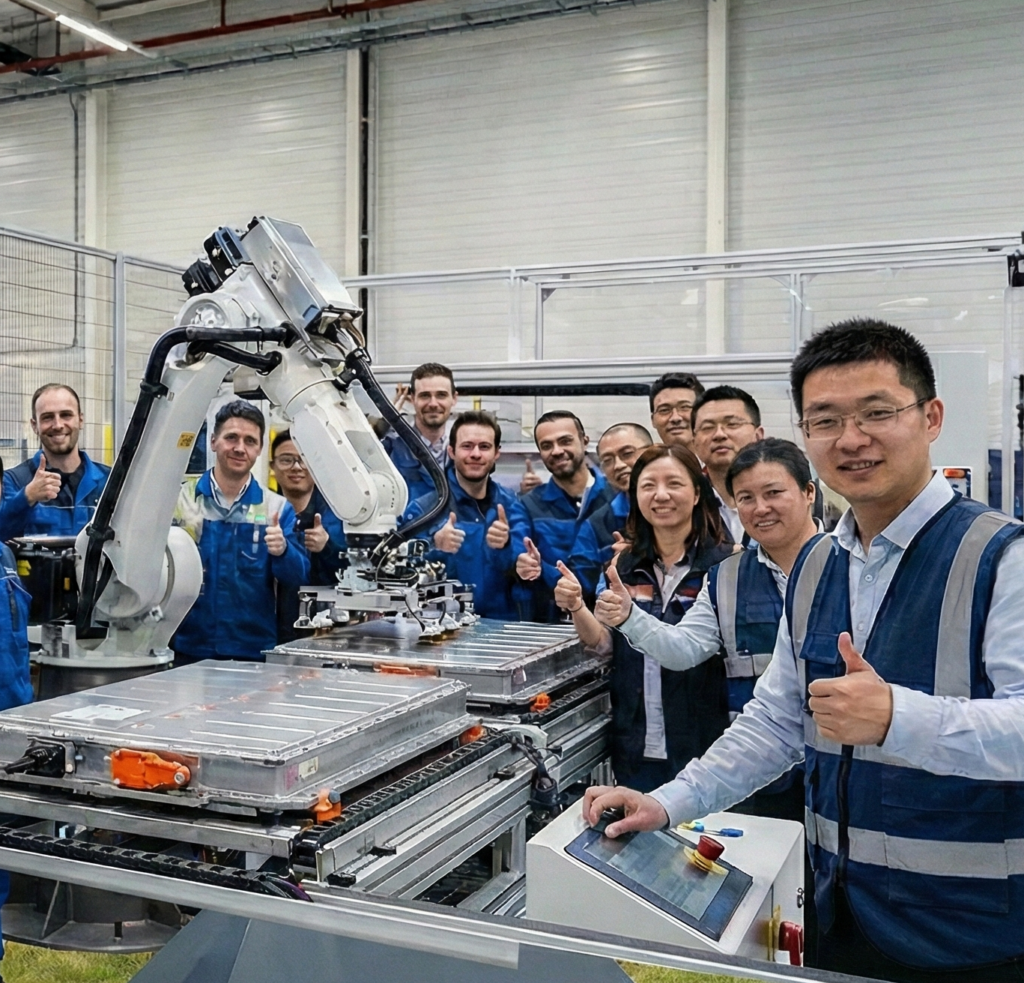
The Era of Reverse JVs
INTRODUCTION: “FOR SURE”
We all remember Emmanuel Macron’s “For Sure” catchphrase at Davos, which has almost become a meme in the corridors of large corporations and on social media.
In reality, this “For Sure”, addressed to global investors and above all to the Chinese, marked a turning point for our industry. At Davos, the message was crystal clear: France no longer holds technological superiority. The rhetoric of “European Sovereignty” has morphed into an industrial arms race in which we court Chinese partners to establish their know-how on our soil.
- “China is welcome, but what we need is more Chinese foreign direct investment in Europe in some key sectors to contribute to our growth, to transfer some technologies and not just to export towards Europe some devices or products …”.
This note does not deal with geopolitics (out of scope). It deals with the cognitive gap that causes negotiations to fail. MadameChina’s angle: what happens in the meeting room. This note is neither a critique nor a plea. It is a framework for reading negotiation frictions — to reduce misunderstandings and accelerate execution.
I. THE MACRO CONTEXT: THE REVERSAL AND REVERSE JVs
Thirty years ago, France’s industrial champions dictated their terms to Beijing. Today, the hourglass has been turned over. We have entered the era of reverse learning. Batteries and electric vehicles are the most acute symptom of this trend.
II. CASE STUDIES: MAPPING CHINESE INVESTMENT IN EUROPE AND FRANCE
To grasp the scale of the challenge, we need to analyze how and where Chinese champions (CATL, Envision, BYD) are investing on the continent.
1. CATL: European Integration Through Joint Ventures
Chinese battery giant CATL (Contemporary Amperex Technology Co. Limited) has pursued an industrial localization strategy in Europe built on massive investment and equity partnerships with legacy automakers.
Industrial Footprint:
- In Germany (Eisenach, Thuringia): The 14 GWh plant, CATL’s first European site, started production at the end of 2022, mainly to supply Mercedes-Benz. It marks the first step of China’s industrial presence in the heart of automotive Europe.
- In Hungary (Debrecen): A €7.3 billion investment for 100 GWh of capacity, intended for customers BMW, Stellantis and Volkswagen. Early 2026 marks the start of production at this megafactory, positioning Hungary as a hub of the European battery supply chain.
The Stellantis Partnership: From Supplier to Joint Venturer
The relationship between CATL and Stellantis illustrates how Sino-European industrial ties are changing in the sector:
- Supply phase (2016-2024): For eight years, CATL supplied batteries to PSA and then Stellantis, building a structured commercial relationship before any equity agreement.
- The December 2024 Alliance : A 50/50 joint-venture agreement worth €4.1 billion turns the customer-supplier relationship into an industrial co-investment. Stellantis thereby secures its supply of LFP (Lithium Iron Phosphate) batteries for the entry-level and mid-range segments.
- The Zaragoza Plant in Spain (2026): Construction began in November 2025, with production due to start at the end of 2026. This 50 GWh plant will produce LFP cells exclusively, the technology Stellantis favors to cut the cost of affordable electric vehicles.
Situation: CATL is moving from supplier to strategic co-investor. Through equal-share joint ventures and LFP technology, the Chinese group is putting down lasting roots in the European ecosystem, while Stellantis diversifies its battery supply sources in the face of Asian competition.
2. Envision AESC: The Linchpin of France’s “Battery Valley”
In Douai, the Chinese group Envision has become Renault’s lifeline.
- Situation: Mass production has begun to equip the new electric Renault 5.
- What’s at Stake: The first phase (9 GWh) targets 1,000 jobs, with a goal of 30 GWh by 2030. Here, the transfer is not theoretical: it is physical. French teams are being taught to run a clean room with a minimal “scrap rate”, whereas our engineers had until now struggled to stabilize chemical processes at scale.
3. BYD: The Integrated Champion
BYD (Build Your Dreams) follows a different logic: it assembles the entire car.
- In Hungary (Szeged): Pilot production has just started this February 2026. It is the first passenger-car plant of a Chinese automaker in Europe.
- In Turkey (Manisa): To get around EU tariff barriers while staying within the customs union, BYD is launching a massive site that will serve as an ultra-competitive rear base. BYD is not asking permission to come in; it is building walls inside the European fortress.
III. THE STRENGTHS OF “SITE FRANCE”: WHY WE ARE (AND WILL BE) THEIR PRIORITY
If France has been Europe’s No. 1 destination for foreign investment for the sixth year in a row (EY Barometer 2025), it is no geographical accident. For headquarters in Shenzhen, France offers competitive advantages that even Germany can no longer match.
1. The “Shanghai + Beijing of Europe”: Centrality and Prestige
For a Chinese investor, setting up in France means setting up at the very core of Europe’s political reactor.
- The Political Epicenter: China sees France as the “brain” of the European Union. Just as the first foreign investors in China rushed to Shanghai and Guangzhou rather than the peripheral provinces, giants like BYD see Paris as the center of gravity where tomorrow’s standards are decided.
- Proximity to Markets: France offers direct access to all the major neighboring markets (Germany, Italy, Spain, UK) with world-class transport infrastructure.
2. The Secret Weapon: The Nuclear Energy Mix
This is probably the asset most underestimated by the French, yet the most closely watched by Beijing.
- The Carbon Passport: With the entry into force of the EU Battery Regulation, the carbon footprint of manufacturing becomes an exclusion criterion. Producing a battery in France with nuclear electricity emits up to 10 times less CO2 than in Germany or Poland (coal-based).
- The Competitive Edge: For CATL or Envision, France is the only country able to supply a massive, stable “green electron” at a state-negotiated price. It is their guarantee of regulatory survival in the European market.
3. The Strategist State and Verticality
The Chinese are baffled by German federalism or Brussels bureaucracy. By contrast, they love French verticality.
- “Top-Down”: When the Élysée announces a project at the Choose France summit, the entire state apparatus (Bercy, the Regions, prefectures) switches into “fast-track” mode. This ability of the state to “roll out the red carpet”, streamline industrial building permits and line up massive subsidies (IPCEI) creates a climate of trust that feels familiar to Chinese CEOs used to Beijing’s dirigisme.
4. Technological Excellence and Human Capital
China is not coming for low cost (it won’t find it here); it is coming for technical reliability.
- Cutting-edge engineering: Our engineers and technicians are recognized for their ability to manage complex processes (chemistry, automation, nuclear).
- R&D: France remains Europe’s leader in hosting foreign R&D centers. The Chinese see our laboratories as a way to “co-innovate” and adapt their products to the tastes and ultra-demanding standards of European consumers.
5. Strategic Autonomy: The Diplomatic Factor
Historically, China respects France for its “non-aligned” stance and its pursuit of autonomy from the blocs (the Gaullist-Mitterrandist doctrine).
- A distinctive voice: Amid rising tensions between Washington and Beijing, France is seen as a more pragmatic partner, less inclined to blindly follow American diktats than other Northern or Eastern European countries. It is a diplomatic life insurance policy for their long-term investments.
IV. THE “MADAME CHINA” ANGLE: AT THE HEART OF THE DEADLOCK: TECHNICAL OR COGNITIVE?
BUT Why, despite surface-level attractiveness and mutual needs, do large-scale industrial Joint Ventures (JVs) remain so rare and complex to sign in France?
1. “Out of Scope”: Geopolitical and Structural Factors
It seems obvious that the main obstacle to China investing massively in French industry remains geopolitical (record trade deficit, rigorous investment screening under the IEF decree, pressure from the Washington-Brussels axis) and structural (labor costs, production taxes). These extremely complex variables will not be the subject of my analysis here. My vantage point focuses on the most sensitive point of friction, the “black box” of our discussions: technology transfer and the role of the cognitive gap
2. The Regulatory Wall: Beijing’s “Tech Fortress”
In 2025, Beijing completed a legislative arsenal that turns industrial secrecy into a legal impossibility. It is no longer simply that Chinese manufacturers do not want to share; they can no longer do so without the approval of MOFCOM (the Ministry of Commerce).
Summary of transfer restrictions (status as of February 2026):
| Industry | Targeted technology | Legal mechanism (China side) | Impact on the JV in France |
| EV batteries | LFP cathodes, lithium processing, production equipment (winding, stacking). | Announcement No. 58 (Nov. 2025): Inclusion on export control lists (dual-use items). | Detailed process transfer becomes semi-impracticable. Any “manufacturing manual” must be cleared by Beijing. |
| Aerospace & Drones | High-density batteries (≥300 Wh/kg), control systems, composite materials. | Central Military Commission oversight: National security licensing requirements. | Near-systematic blocking of in-depth technical cooperation. Risk of reclassification as “military”. |
| Semiconductors | Advanced nodes, advanced packaging, design IP. | Export Control Law: Response to foreign sanctions. | License refusals for critical segments. Major administrative risk for the Chinese executive. |
| AI & Data | Algorithms (GenAI), model architectures, associated data flows. | Cybersecurity & Data Security Laws: Localization requirements and algorithm audits. | Sharing model “code” or “parameters” (weights) is treated as a sensitive export. |
| Biotech | Human genetics, modification protocols. | Biosecurity Laws: Prior authorization for sharing genetic resources. | Legal uncertainty and high criminal risk when sharing bio-data. |
The Tactical Lever: Chinese manufacturers (CATL, BYD) systematically use these constraints as a “convenient shield”. At the negotiating table, a refusal to transfer is never presented as a lack of will, but as a state veto. This lets them keep full control of the IP while shifting responsibility for the deadlock onto their regulator.
3. Finesse in Negotiation: Two Cultures of Accountability
The collision is not between a rigid negotiator and a flexible partner. It is between two legitimate ways of formalizing trust.
- Cartesian Perfection: On the French side, writing down a date, a deliverable or a performance clause is not a sign of distrust — it is the legal translation of a promise. A written commitment protects both parties. This is the culture that built international commercial law.
- As a result, the French negotiator wants everything defined, written down and time-bound from “Day 1”. He demands total visibility: “In month 18, we must receive the technical manual for cathode X”.
- Confucian Pragmatism: For the Chinese partner, knowledge transfer is an organic process that will happen “de facto” in the workshop (on the shop floor). It is a natural osmosis. To him, a penalty clause is an insult to the relationship of trust (Guanxi); it turns a partnership of shared destiny into a distrustful transaction.
- His philosophy is: “I want to do it, but I don’t want to commit formally to a fixed date because the context may change”.
- Both are right within their own system. Both are wrong within the other’s.
4. The Irony of Copying: The Poacher Turned Gamekeeper
It is fascinating to watch this reversal of history. The Chinese learned Western technology by observing it on the ground, often without any official transfer, by absorbing it directly on the production line. Today, steeped in this culture of pragmatism, they fear — and expect — that France will apply their own recipe to them.
Those who practiced “learning by observation” for three decades are now the fiercest protectors of their own intellectual property. They know better than anyone that the real industrial secret lies not in the contract signed by the lawyers, but in the manufacturing process.
V. STRATEGIC RECOMMENDATIONS
To unlock these Joint Ventures and secure our future sovereignty, we must take a page from China’s strategy of the past 30 years: attract, absorb, then surpass.
1. Communicate and Collaborate: Chinese regulatory constraints create a situation in which the Chinese partner cannot formalize the transfer, even if it wanted to. At the negotiating table, this reality is indistinguishable from a deliberate refusal. The distinction between ‘cannot’ and ‘will not’ is the first misunderstanding to resolve. Always ask: “What is the MOFCOM approval process? What is the realistic timeline?” This turns the deadlock into a roadmap.
2. The Way Up and Out: Contract on the Framework, Trust on the Content. Formalize what structures the relationship (governance, access to the shop floor, upskilling of French teams). Leave organic what cannot be otherwise: the actual pace of knowledge transfer. This is the synthesis of the two logics — and it is where lasting JVs are won.
3. The “Reverse Trojan Horse” Strategy:
- Don’t waste six months negotiating the transfer of PDF files that will be obsolete before they are read. Negotiate extensive training hours and engineer exchanges. The know-how lies in the hands of the people who set up the machines in China. Send our engineers there.
- Accept that the plant will be run by the Chinese during the first years. The goal is to absorb the method through practice (Learning by doing). Include contractual clauses providing for key operational positions to be filled by French staff as our managers build up their skills.
4. The Cultural “Go-Between”: JVs fail over misread silences. Every Board should have a mediator/advisor able to explain to the French CEO that refusing to sign a specific clause is not a refusal to collaborate, but a cultural protection of know-how that must be worked around through the human relationship. Google or AI translation cannot convey cultural nuance and what goes unsaid.
5. Use Geopolitical Strength: Remind the Chinese partner that France is its life insurance in Europe against protectionism. Let us leverage our political and economic assets in negotiations to secure the location of an R&D center — not just assembly operations. This is your strongest argument, because it is our irreplaceable competitive advantage.
CONCLUSION:
The “Great Reversal” is neither inevitable doom nor a humiliation. It is a tactical opportunity. By agreeing to be the student today, France gives itself the means to become the master again tomorrow. We have the energy, we have the geographical position, and we have the talent. All we lack is the cultural agility to turn these Chinese plants into springboards for the next generation of French industrialists.