The K-Shaped Economy: The Lower Branch Is Rewriting the Grammar of the Chinese Market
Why “unknown” brands are setting a new execution standard in China, and how multinational brands will have to respond
Introduction
Everyone is talking about the K-shaped growth of the Chinese economy. Industrial investment is galloping, consumption is lagging. It has become the received wisdom of Goldman and McKinsey notes.
But received wisdom can be misleading.
The lower branch of the K, the one said to be “stalled”, is precisely where China’s real economic innovation is being built. Not through downgrading, not by default, but through creative constraint. When consumers demand extreme value for money and refuse to be taken for a ride, a brand can only survive through execution discipline. Low prices are no longer a marketing positioning; they are an industrial infrastructure.
McKinsey projects that 66% of Chinese consumption growth through 2030 will come from tier 3 and below.
Three players illustrate this shift. AiYiFu (爱依服), 5,000 women’s clothing stores and 10 billion yuan in revenue. DUSTO (大东), 9,000 women’s shoe stores and 5 billion yuan. YiNeng (依能), beverages worth 3 billion yuan and more than a billion cases sold per year.
None of these names appears in Western analyses of China. None has run a global campaign. None has an office in Paris or New York. And yet they now set the new standard of the Chinese market.
I. The Three Players of Frugality
1. AiYiFu (爱依服): The Hegemon of Peripheral Apparel Founded in 2004, this women’s ready-to-wear brand generates annual revenue approaching 10 billion RMB (€1.25 billion), technically surpassing historic players such as Peacebird (Taipingniao) and JNBY. Aiyifu operates a massive network of more than 5,000 physical stores. The brand has methodically ignored tier-1 megacities in order to saturate tier-3 and tier-4 markets, county seats and small towns. Its advantage: total territorial dominance with an average price per item ranging from 50 to 200 RMB (€6 to €25), while paradoxically maintaining a gross margin above 60%.
Ranking: Number 1 among local women’s fashion brands in China in terms of revenue, physical network density and market share in lower-tier cities. The industry calls the company the “invisible Number 1” (隐形女装一哥)
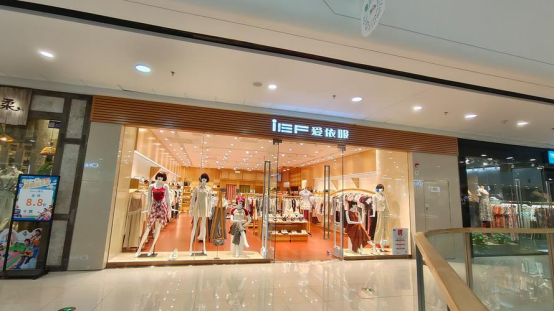
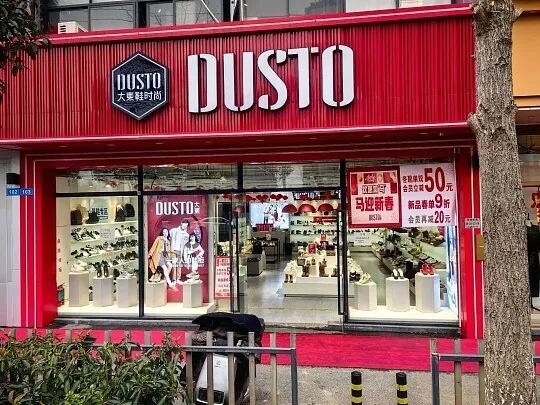
2. DUSTO (大东): The Just-in-Time Footwear Champion Founded in 1995, DUSTO has redefined the women’s footwear sector. The group reports annual revenue of 5 billion RMB (€625 million), driven by a colossal network of more than 9,000 stores. Its industrial infrastructure rests on 107 production lines running continuously, with a daily output of 300,000 pairs. DUSTO applies an ultra-aggressive pricing policy (often 79 RMB / €10 for two pairs), targeting neighbourhood markets and secondary pedestrian streets, while claiming “zero inventory” management.
Ranking: Undisputed Number 1 in women’s footwear in the hyper-volume, peripheral segment. The sector refers to it as the “Underground Shoe King” (地下鞋王).
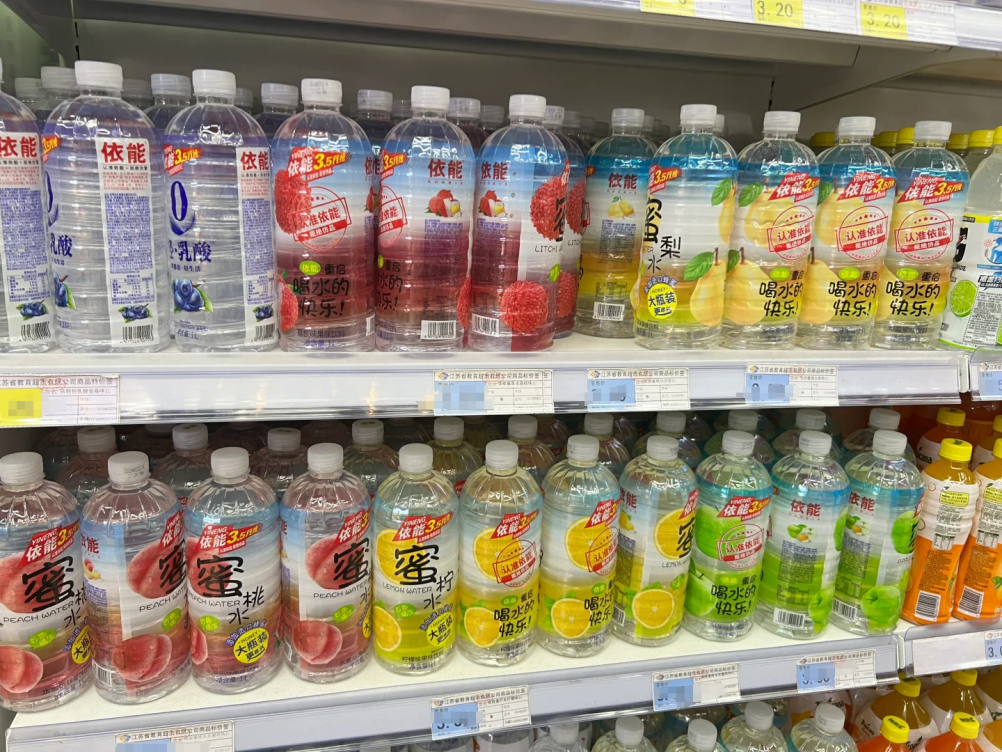
3. YiNeng (依能): The Assault on Fast-Moving Consumer Goods (FMCG) In the beverage sector, dominated by oligopolies such as Kangshifu (Master Kong) and Uni-President, YiNeng has passed the 3 billion RMB revenue mark (€375 million). In 2024 alone, the brand sold more than a billion cases, relying exclusively on hard-discount supermarket channels (such as Ling Shi Hen Mang). The positioning is ruthless: a one-litre bottle of flavoured water sold at 3.5 RMB (recommended retail price), dropping to 2.2 RMB in discount networks, an unbeatable volume-to-price ratio on the market.
Ranking: Top 20 beverage brands in China, and national Number 1 by market share in the very specific flavoured water segment (果味水).
II. Frugality as Engineering, Not Positioning
The Western analytical error is to treat these brands as conventional low-cost players. That is wrong. European low-cost lives with crushed margins and chronic inventory risk. These Chinese players have done the opposite: they have mathematically eliminated intermediary margins and neutralised inventory risk upstream.
Two levers converge.
1. Absolute vertical integration. DUSTO runs its own manufacturing, YiNeng owns its production plants and its packaging plant, AiYiFu fully controls its buyer-driven sourcing. No margin escapes the system.
2. Capital turnover velocity. These players have buried the Western predictive model in favour of 小单快反 (xiǎo dān kuài fǎn, “small orders, fast response”): 14 days for the design → store cycle (DUSTO), 7 days to test a product’s viability on the shelf, 48 hours to restock a bestseller (AiYiFu).
These brands are less brands than distribution and cash-flow machines. Their product is not a T-shirt or a shoe. It is turnover.
III. The Expansion Strategy: 农村包围城市 “the countryside encircles the cities”
European brands attack a market from the top (Shanghai, Beijing) and then work their way down. These players did the opposite. It is the modern application of a Maoist military concept: 农村包围城市 (nóng cūn bāo wéi chéng shì, “the countryside encircles the cities”).
Phase 1 — Monopolising the periphery (tiers 3 to 5). Massive, dense roll-out in areas where customer acquisition costs and rents are marginal. AiYiFu has never opened in Beijing’s Sanlitun. DUSTO has never targeted Plaza 66. YiNeng is not on the shelves at City’super. All three first took China’s 1,341 counties.
Phase 2 — The assault on urban centres. Once economies of scale have been secured in the periphery, the move upmarket begins. Ling Shi Hen Mang (零售很忙), parent of the snack hard-discount segment that distributes YiNeng, is now attacking Shanghai via its residential outskirts. AiYiFu is opening in tier-1 Wanda Plazas. DUSTO is arriving in Beijing.
McKinsey projects that 66% of Chinese consumption growth through 2030 will come from tier 3 and below. These players are already there. European brands are looking at the remaining 34%.
IV. Three Sharp Ruptures
To assess an operator’s viability in this market, you have to measure how well it fits three structural ruptures. No Western brand in China currently ticks all three boxes.
Rupture 1 — Stripping franchisees of decision-making power. At AiYiFu, franchisees are stripped of all power: no say over the assortment, no pricing authority, no purchasing power. Headquarters dictates 100% of flows through algorithmic management. In exchange for this operational submission, the central algorithm bears the entire financial risk of unsold stock, through automatic nationwide balancing between stores. Human error is removed from the chain. The philosophical contradiction: promising freedom to the consumer by removing all freedom from the franchisee.
Rupture 2 — The B2B “Zero Friction” protocol. Access to hard-discount channels requires the Four Zeros rule (四个零): zero listing fees, zero retailer marketing budget, zero payment terms, zero returns. The rule eliminates what accounts for 20 to 30% of the price in traditional supermarkets. The product is invoiced on a 裸价直采 basis (luǒ jià zhí cǎi, “direct sourcing at bare price”): at gross logistics cost, with no intermediary margin. It is precisely this channel that enabled YiNeng to deliver extreme value for money to consumers, and that became its expansion protocol.
Rupture 3 — The psychological rationalisation of consumption. Buying cheap has been destigmatised. Consuming low-cost is socially validated, peer to peer, on Douyin and Xiaohongshu as proof of economic savvy. The proudly claimed concept of 穷鬼快乐水 (qióng guǐ kuài lè shuǐ, “the poor man’s happy water”) is championed by consumers themselves, not by brands. Cheap becomes acceptable when it is staged as smart.
Chinese consumers hunt for extreme value for money, unapologetically and without detours.
V. Aldi Has Responded. The Three Chinese Brands Have Responded. Who’s Next?
Three major incompatibilities threaten Western operators in China.
1. The middle market has been mathematically destroyed. A brand that justifies a price premium by its European “heritage”, without demonstrable functional innovation, will be squeezed out. The Chinese market is polarising between ultra-luxury (decoupled from use value) and optimised frugality. Mid-market players (Decathlon, Carrefour, mid-range European fast fashion) are the first in the firing line.
2. The European supply chain is obsolete. A chain steered from Europe with six-month design cycles is disqualified in a market that runs on 14 days. Adidas China sketched out the antidote in our previous note: total decentralisation, local autonomy, decisions within 72 hours without going through headquarters. (see the previous note)
3. FMCG is being suffocated. Cost structures weighed down by massive advertising rule out access to the Four Zeros. Snack hard discount (零食量贩) captured 37% of snack sales in China in 2024, ahead of supermarkets (22%) and e-commerce (20%). Coca-Cola, Pepsi, Master Kong, Uni-President and Wahaha have not yet cracked this channel. How long will they hold out?
The imminent question is simple. Aldi has given its answer: adapt its German discount DNA to Chinese culture and reposition as “proximity premium” (see the previous note). The three Chinese brands have given theirs: engineered frugality, territorial encirclement, the Four Zeros.
What will the multinational brands’ answer be?
Push further into the tier 3-4-5 下沉市场? And how?
With what product, when 14 days now dictate the cycle and yours run on six months? With what supply chain, when European headquarters demands margins, standards and processes? With what distribution, when your traditional KAs and wholesalers are losing share and you do not know how to operate in hard discount?
These three questions are not rhetorical. They are operational, immediate, and unanswered for 95% of the Western operators present in China.
The Final Word
The global standard for retail and FMCG is no longer written in Paris, New York or Bentonville. It is written in Foshan, in Wenzhou, and in the 1,341 Chinese counties conquered by AiYiFu, DUSTO and YiNeng.
The choice is no longer “invest in China or not”. The choice is “stay compatible with the new standard, or accept being squeezed out”.