The Chinese “Button”: How Adidas Redefined “Glocal” in China
From Analysis to Offensive
This report is your foothold. To dig deeper into these signals, audit your strategic position or secure your operations on the ground, start a conversation with our experts.
For three decades, the dogma of multinational FMCG marketing for the Chinese market boiled down to one portmanteau word: “Glocal”. The idea was simple: a global strategy designed at headquarters (Berlin or Paris), sprinkled with a little Chinese sauce for window dressing. But in 2026, this model has officially been transformed into “China for Global”.
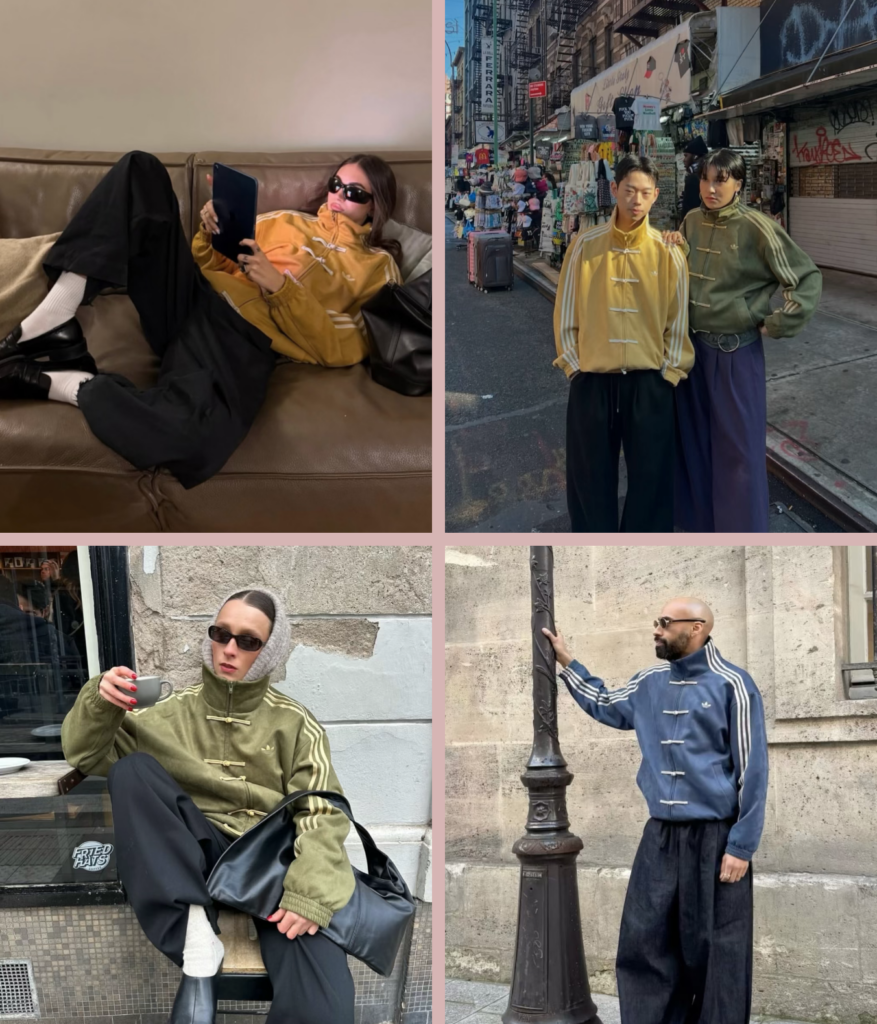
The undertaker? A small Chinese button made of twisted fabric: the Pankou 盘扣.
By achieving the impossible — turning a traditional Chinese garment (the Tang jacket) into an object of universal desire, and turning the classic Adidas “track top” into a cutting-edge fashion piece — Adidas did not just rescue its China accounts. The brand invented “China for Global”: the moment when the cultural periphery becomes the command centre of global style.
Let’s break it down.
I. Adidas’s incredible resurrection in China: from “Glocal ” to “ In China for China“
1. Free Fall (2021-2022): The Year of Living Dangerously
In 2022, Adidas is a brand “in intensive care”. Hit by the boycott over Xinjiang cotton and by lockdowns, it sees its Greater China revenue plunge by 36%.
- Locked-in positioning: The market is caught in a vice between Nike, holding firm thanks to its technical hegemony, and local giants Anta and Li-Ning, which saturate the space with “Guochao” (national pride).
- The disaster: Adidas slips to 4th place in the market, weighed down by EUR 400 million of unsold inventory and a brand image perceived as “arrogant and out of touch”.
2. The Gulden Pivot and Shanghai’s Autonomy (2023)
Fortunes changed in January 2023 with the arrival of Bjørn Gulden (ex-Puma). His diagnosis was radical: Adidas must stop being a German brand that sells in China, and become a Chinese brand backed by German engineering.
- “In China, For China” strategy: He handed full powers to the local team led by Adrian Siu.
- The Design Center: The Shanghai creative centre became the brand’s nuclear reactor. The share rose to >60% of products designed locally (95% manufactured locally).
3. Inventing the Pankou: From Iteration to Success (2024-2026)
Success was not a “one-shot”, but a surgical iteration:
- 2023 (V1 – The failure): Clumsy Chinese characters on polyester. Too cliché.
- 2024 (V2 – The spark): First integration of the Pankou button (traditional Chinese button) on the track top. The product draws attention on Douyin.
- 2025 (V3 – The apotheosis): Materials switch to denim, faux suede and corduroy. The cut is simplified to make it wearable every day. Then comes the explosion: the garment becomes a universal fashion item.
4. The Proof in the Numbers
This creative agility transformed the balance sheets:
- Growth: While Nike sank into a structural crisis with a -17% drop in the last quarter of 2025 (its fifth consecutive quarterly decline in China), Adidas displayed insolent health: +13% growth for the year, marking its eleventh consecutive quarter of growth on Chinese soil.
- Reconquest: Adidas regained its position as no. 2 among international brands and moved back ahead of Li-Ning in overall “Lifestyle & Apparel” market share.
- Value: The average selling price (ASP) jumped from 520 RMB to 720 RMB in 5 years, against China’s deflationary backdrop, turning a declining sports brand into an icon of premium desirability.
II. Digital Has No Borders: from “In China, for China” to “China for Global”
1. The Multiplier Effect of UGC (User Generated Content)
The global success of the “Pankou Jacket” owes nothing to a traditional multi-million-euro advertising campaign. It was born of a cultural “hack” on TikTok.
Patient zero – @visco: This Sino-Japanese blogger, an icon of the “Genki” (vitality) style, was the catalyst. Her videos mixing the Adidas jacket with Chinese buttons and pieces by independent designers broke the codes. It was no longer sportswear; it was “Neo-Chinese Chic”.
The algorithmic amplifier: ByteDance’s algorithms (Douyin/TikTok) favour “Visual Density”. An Adidas logo (Western) paired with a Pankou button (Eastern) creates a “visual friction” that the AI identifies as content with high engagement potential. It was this contrast that propelled @visco’s videos onto “For You Pages” all over the world, without Adidas having to pay for it.
The proof in the numbers: The hashtag #adidastangjacket smashed the counters with more than 500 million views. Even more impressive: 70% of the user-generated content (UGC) came from users outside China, proving that the “Shanghai” aesthetic had universal pulling power.
It was no longer Adidas promoting itself. It was Shanghai’s youth telling the rest of the world: “Look how we have reinvented this German brand.”
2. An Unexpected Outcome: The “Reverse Daigou” Phenomenon
This is undoubtedly the most fascinating point. For years, “Daigous 代购” were Chinese people living in Europe who bought luxury goods in Paris or Milan to resell them in Shanghai.
From 2025 onwards, we are witnessing the opposite phenomenon. Europeans and Americans, frustrated at not finding Shanghai’s exclusive collections in their own countries, are using agents in China to import these pieces.
The resale desirability index (eBay/StockX): On eBay and StockX, Pankou jackets resell at premiums of 30% to 50%.
The analysis: In the fashion industry, such a price gap on a product that was “not limited” at launch is irrefutable proof of an information asymmetry created by social media. The algorithm did its job: it made the product a “cult” item in London when it could only be bought in Shanghai.
3. Globalisation and Restocking (Q1 2025)
As soon as the first signs of “Reverse Daigou” (buying in China for resale in Europe at premiums of 30% to 50%) were detected, Adidas activated its global battle plan – “China for Global”.
- The global roll-out: From the first quarter of 2025, Adidas officially opened the floodgates. The brand orchestrated a phased distribution in Europe, Japan and South Korea. The goal: cut the ground from under the grey market while maintaining organised scarcity.
- The technical adjustment: To guarantee global success, the Shanghai studio made micro-adjustments to the cut (sizing). The product was subtly reworked to fit international body types without losing the essence of its “Boxy” and “Tang” design.
- The Ambassadors: The brand activated its global “power matrix”. The jacket’s organic appearance on the social accounts of BLACKPINK and the idol Song Yuqi acted as a particle accelerator.
- Western media: The gatekeepers took up the baton. Special features in Vogue and Hypebeast elevated the “Chinese-button jacket” to the status of a global fashion phenomenon.
III. Takeaways for the Multinational C-Suite: Why the Future Is “Multi-Local”
1. Cultural Appropriation: From Caricature to Icon
The success of Adidas’s Pankou button is not merely aesthetic; it is the symptom of a Cultural Intelligence that few international brands have managed to master. For decades, Western brands practised a lazy “Chinoiserie”, treating a millennia-old culture as a mere sticker catalogue to slap onto European products.
The counter-example: November 2018. Dolce & Gabbana launches a video campaign on Weibo to promote its Shanghai show. The concept: a Chinese woman in a D&G dress clumsily trying to eat pizza, spaghetti and a cannoli with chopsticks.
The damage was immediate: The Shanghai show was cancelled. D&G products were pulled from Chinese e-commerce platforms. The boycott was massive, immediate and nationwide. Seven years later, D&G remains persona non grata on Chinese social media.

2. Letting Go: Radical Autonomy
Adidas’s success stems from the fact that headquarters in Herzogenaurach agreed to become a resource provider rather than a giver of orders. The Shanghai creative centre does not need to ask permission to change a button or alter a cut. This autonomy is the only cure for the bureaucratic sluggishness that is currently killing Nike.
3. Plasticity vs Nationality
The Chinese consumer of 2026 is sophisticated. They are not looking for a “Chinese brand” out of pure nationalism, but they reject foreign brands that treat them with condescension. Adidas succeeded because it became “plastic”: it absorbed local culture without caricaturing it. It does not sell “German sport”; it sells global culture infused with Chinese design genius.
4. Reverse Innovation
The upcoming opening of the Oriental Creative Lab in 2026 marks a new era of design. This centre will not just create for China; it will export its concepts to Europe. The Pankou button is only the beginning. Tomorrow, it could be materials, fastening systems and store concepts born in Asia that define the Champs-Élysées flagship.
Conclusion: The Button That Stitched the World Back Together
In 2026, a brand’s identity is no longer defined by its headquarters, but by its cultural agility. The Pankou jacket is not just a garment: it is the manifesto of a historic shift.
This success is the fruit of a radical metamorphosis: the shift from “In China for China” (a local survival strategy) to “China for Global” (an engine of global desire). Adidas has buried top-down “Glocal” — where the centre dictates the norm to the periphery — to invent Reverse Innovation.
The Pankou button is the suture point of this new era. It proves that the “Designed in Shanghai” label may now carry more weight in the imagination of global Gen Z than “Made in Italy”.
Do you have a matter on which an outside perspective would be useful?
Sources are not cited in this note so as not to weigh down the strategic reading. If you are interested and a subscriber, you can send us your specific questions by replying directly to the subscriber-only newsletter. The MadameChina team will get back to you with the necessary details.