Beyond Analysis
Information alone is no longer enough to secure a deal. For your investments, JVs, complex negotiations or cross-border facilitation, MadameChina supports you as a strategic partner.
Chinese Tourism in France – The End of Mass Tourism, the Beginning of Class Tourism?
EDITOR-IN-CHIEF’S NOTE
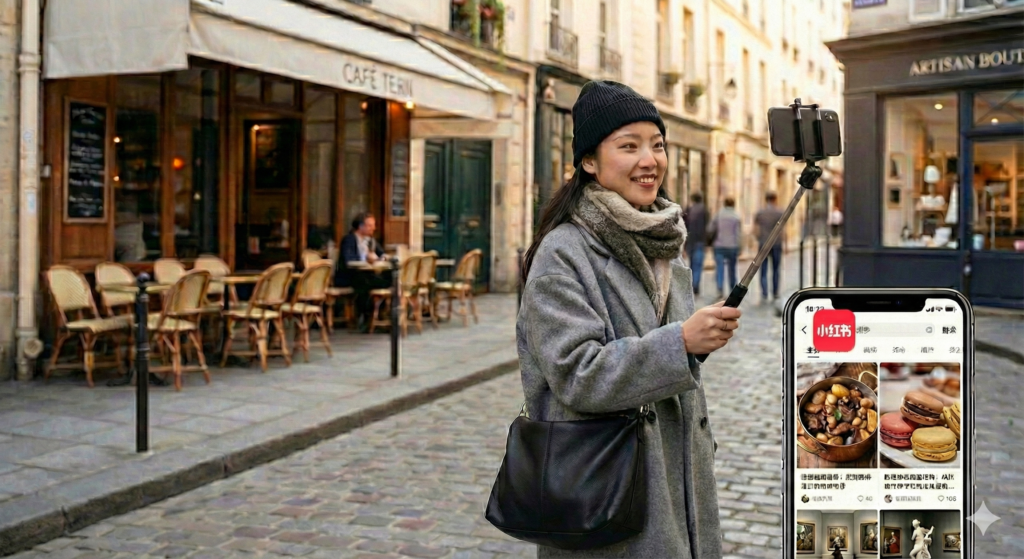
2025 marks not only the return of Chinese tourists to France, but also a structural break with the past. Forget 2019 and its convoys of coaches: the Chinese traveler has transformed, trading shopping lists for a quest for immersion dictated by the Xiaohongshu (RedNote) algorithm. In this special Chinese New Year 2026 edition, Madame China decodes this gradual shift from “Shopping” to “Lifestyle”, where value no longer lies in the object owned, but in the moment lived.
Despite the economic gloom in China over the past two years (real-estate crisis, cautious consumer spending), the resilience of the desire for France is remarkable: tourist volumes jumped by +60% to +80% in 2024/2025. But beware: the tourist landing at Roissy today is no longer the “Walking Wallet” of 2019. We are witnessing a complete reinvention of the model: a shift from displaying social status (buying logos) to a quest for identity and emotion. For Paris, the capital of the French Art de Vivre, this is a unique opportunity to capture unprecedented value.
1. THE NUMBERS: A SPECTACULAR RECOVERY
- The Quantitative Rebound: After a restart year in 2023 and a transition year in 2024, 2025 shows growth of +60% compared to 2024. This momentum is all the more impressive given the context of cautious consumer spending in China’s domestic market.
- The Change in Profile: The group “mass tourist” has been replaced by the “Free Independent Traveller” – an elite and upper middle class that is younger, better educated and more independent.
- The “Lifestyle” Average Basket: While compulsive logo buying is declining as prices are harmonized globally, budgets are being reallocated to experiences. Average spending on gastronomy and personalized services has jumped by +25%.
Profile Shift: Chinese Tourism in France
Strategic Comparison: The “Volume” Era (2010-2019) vs The “Value” Era (2024-2026)
2010 – 2019: The Mass Industry
- Model: Groups of 30-50 people (Coach)
- Focus: “10 countries in 8 days”
- Digital: Offline booking / Agencies
- Payment: Cash & UnionPay cards
2024 – 2026: The Experiential Elite
- Model: FIT & Small groups (6-15 people)
- Focus: Local immersion (7-10 days)
- Digital: Fully online (XHS / Ctrip)
- Payment: Mobile (Alipay / WeChat)
| Dimension | Yesterday (2010-2019) | Today (2024-2026) |
|---|---|---|
| Age & Profile | 35-55 years old (Gen. 70s/60s) | 30-45 years old (Gen. 80s/90s – 66%) |
| The “Driver” | Status Buying (LV/Rolex logos) | Quest for Culture (Museums/Craftsmanship) |
| Shopping | 60% of budget (Global Brands) | 50% of budget (Niche & Designers) |
| Gastronomy | Chinese Restaurants / Groups | 38% seek the Michelin experience |
| Accommodation | Budget hotels on the outskirts | 73% Boutique Hotels & Palaces |
The Traveler’s New “Labels”
2. PARIS: THE NUCLEAR REACTOR OF VALUE
Paris is not just making a comeback; it is becoming the sanctuary of quality spending. The most striking figure? Spending per day: China now ranks 2nd worldwide, behind the United Arab Emirates but ahead of the United States. China is now the 2nd largest contributor in terms of total spending in Paris, surpassing its 2019 ranking.
- In Paris: In the capital, the Chinese visitor is now an unshakeable pillar, just behind the United States. And the trend is still upward.
- In France: A climb back to 4th or 5th place is expected in 2025 (after falling to 6th place in 2024).
| Scope | Indicator | 2019 (Ref.) | 2024 (Actual) | 2025 (Proj.) | Change 25/24 |
|---|---|---|---|---|---|
| PARIS / IDF | Visitors (M) | 1,76 | 0,8 | 1,28 ~ 1,44 | +60% to +80% |
| Spending / Day | 460 € | 460 € | 475 € | +3,3% | |
| Total Spending | 24,5 bn€ | 7,9 bn€ | 15,0 ~ 16,5 bn€ | +89% to +109% | |
| Spending Rank | 3rd | 2nd | 2nd | 📈 Rising | |
| FRANCE | Visitors (M) | 2,2 | 1,0 | 1,6 ~ 1,8 | +60% to +80% |
| Spending / Day | 445 € | 460 € | 470 ~ 475 € | +2,2% to +3,3% | |
| Total Spending | 35,0 bn€ | 14,0 bn€ | 22,0 ~ 24,0 bn€ | +57% to +71% | |
3. ANALYZING THE SHIFTS: “MADAME CHINA” INSIGHTS
A. The Strategic Angle: A Qualitative Return and the End of the “Logo” Hunt
In the past, people came to Paris to buy social markers (LV bags, watches) to prove their success. Today, with “Luxury Shame” (shame around conspicuous luxury) in China, the marker has changed. People no longer want to show they have money; they want to prove they have a unique life.
- Impact: Pure shopping is declining in favor of exclusivity. A craft piece unearthed in a Marais workshop, a vintage jewel found at the Saint-Ouen flea market carries more social value on social media than a mass-produced luxury item.
B. The Social Tech Angle: Xiaohongshu (RedNote) or Douyin
The Chinese tourist doesn’t follow the Guide du Routard; they follow the recommendations generated by the RedNote (Xiaohongshu) or Douyin algorithm.
- Algorithmic validation: If your shop isn’t “出片” “ChuPian” (photogenic + validated by influencers), you don’t exist.
- The City Walk phenomenon: This is the massive trend. They adopt the Parisian way of life: strolling aimlessly, having coffee on a terrace. Queues form in front of a simple bakery or a public bench “seen on XHS”.
- Testimonial: “I’m impressed by how dynamic offline retail is in Paris. In China, there are fewer and fewer street shops; everything is either online or concentrated in shopping malls”
C. “Art de Vivre” Immersion: The Authenticity Dividend
This is the great victory of this new model: it is no longer only the luxury majors that benefit from the return of Chinese visitors.
- Culture & Gastronomy: They want to live “like a Parisian”. They seek out local chefs’ tables, expert wine tastings and art workshops.
- Influence: Our artists, our artisans and our neighborhood shops are the new ambassadors of the French lifestyle.
4. OPPORTUNITY RADAR: BUSINESS ACTION PLAN
A. Digital Visibility Strategy: “The Influence Ecosystem”
The goal is to capture the flow of travelers from the planning phase (the dreaming).
- Presence on XHS (RedNote) & Douyin: For an artisan or a local brand, opening an official account or working with an agent to manage it is the modern “business card”.
- Influencer Marketing (KOC/KOL): Work with Chinese people living in Paris. Their audience trusts them to uncover “secret” addresses that classic guidebooks don’t mention.
- “Social-Ready” Scenography: Turn the point of sale into an “Instagrammable” (or rather “XHS-friendly”) place, thereby generating free, organic publicity.
B. Experiential “Slow Tourism”: Immersion and Exclusivity
The new Chinese tourist wants to “live like a Parisian”, but with complete linguistic comfort.
- Themed Workshops in Mandarin: Offer pastry workshops, niche wine tastings or private tours of the Saint-Ouen flea market. The key is hosting in Chinese to remove any cultural barrier.
- Partnerships with the CTrip / Trip.com ecosystem: As you pointed out, TripAdvisor doesn’t exist for them. It is crucial to be listed on Ctrip and to monitor ratings and reviews on these platforms, as they serve as the Chinese “TripAdvisor”.
C. Cultural and Heritage Immersion: “The Resonance of Civilizations”
The Chinese have an immense historical culture and deeply respect European heritage.
- Historical “Storytelling”: Museums and châteaux should offer audio guides or booklets that build cultural bridges (e.g. comparing the era of Louis XIV with the Qing dynasty). They are not just looking for the photo; they are looking to understand the symbol.
- Staged Experiences (the “Heritage” photo shoot): Beyond the selfie in front of the Eiffel Tower, offer professional photo sessions in period costume at historic sites (Chantilly, Vaux-le-Vicomte). This meets their desire to “live history” in an immersive and aesthetic way, while showcasing French heritage.
D. Seamless Digital Hospitality: “Service 3.0”
Make purchasing easier by removing logistical and language pain points.
- Translation and Welcome Tools: Use tablets with instant translation apps designed for retail and, above all, roll out menus and catalogs via QR code in Chinese. This makes customers feel valued and prevents ordering errors.
- Payment and Logistics: Integrating WeChat Pay/Alipay is the bare minimum; the real added value is offering help with digital tax refunds (via apps) and “hands-free” delivery options to the hotel or directly to China.
CONCLUSION
The return of Chinese visitors is a striking reality (+60% growth), but it is a demanding return. They no longer come to consume France; they come to experience it. In Paris, where they are now the 2nd biggest spenders, our ability to offer authenticity and digital fluidity will determine the winners of this new era.
Happy Year of the Horse to all our readers!
Do you have a case that could benefit from a fresh perspective?